
When a homeowner or commercial property manager in Pittsburg, CA suspects a natural gas problem – whether triggered by a faint sulfur odor near an appliance, a sudden jump in monthly PG&E therm usage, or an aging black iron pipe showing heavy surface rust – guesswork is never an acceptable strategy. Because natural gas piping runs concealed through crawlspaces, inside wall cavities, and beneath concrete foundations across East Contra Costa County, surface visual checks alone cannot confirm whether your fuel gas system is intact or actively leaking.
Understanding why professional gas leak inspection matters when a gas problem is suspected highlights the critical difference between amateur DIY checks and calibrated diagnostic testing performed by a licensed plumbing contractor. A professional gas line evaluation doesn’t just confirm whether gas is escaping today – it pinpoints microscopic fitting seepage, verifies regulator operating pressures, identifies code violations, and restores total peace of mind for your household.
Why DIY Soap Checks and Consumer Alarms Are Not Enough
Many property owners assume that plugging in a retail hardware-store gas alarm or brushing dish soap onto an exposed water heater union is sufficient to verify gas safety. In field diagnostics across Pittsburg, Antioch, Oakley, and Brentwood, relying on consumer shortcuts routinely leaves dangerous hazards undetected for three technical reasons:
- Consumer Alarms Have High Detection Thresholds: Retail plug-in alarms are designed to sound only when ambient methane concentrations approach dangerous percentages of the Lower Explosive Limit (LEL) near the specific outlet where the unit is plugged in. Because natural gas is lighter than air, gas leaking inside a wall cavity or ventilated attic rises rapidly without ever triggering a floor-level plug-in sensor.
- 80% of Residential Gas Piping Is Concealed: Brushing soapy water onto a visible flex connector behind your stove tells you nothing about the threaded 90-degree elbows hidden inside your drywall, the manifold joints in your attic, or the buried yard service line running under your driveway.
- Distinguishing Sewer Gas from Natural Gas: Dry plumbing P-traps and cracked sanitary vent pipes release hydrogen sulfide sewer gas that smells remarkably similar to the mercaptan odorant in natural gas. Professional diagnostic equipment immediately distinguishes methane/propane hydrocarbons from plumbing vent odors.
How Licensed Plumbers Perform a Multi-Stage Gas Leak Inspection in Pittsburg, CA
When a licensed plumbing specialist from A1 Phoenix Plumbing responds to a suspected gas issue in Pittsburg, CA, we execute a systematic, non-destructive diagnostic protocol engineered to detect leaks down to parts per million (PPM).
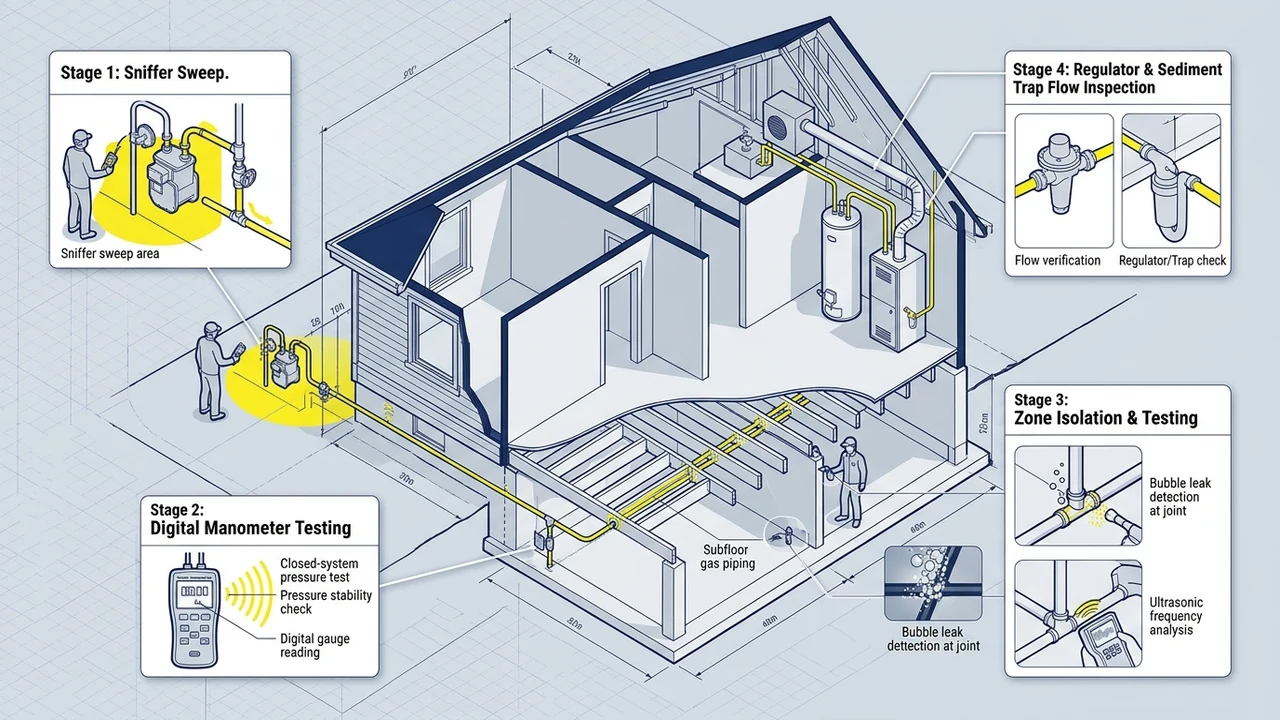
Stage 1: Electronic Combustible Gas Detector Sweep (PPM Sensitivity)
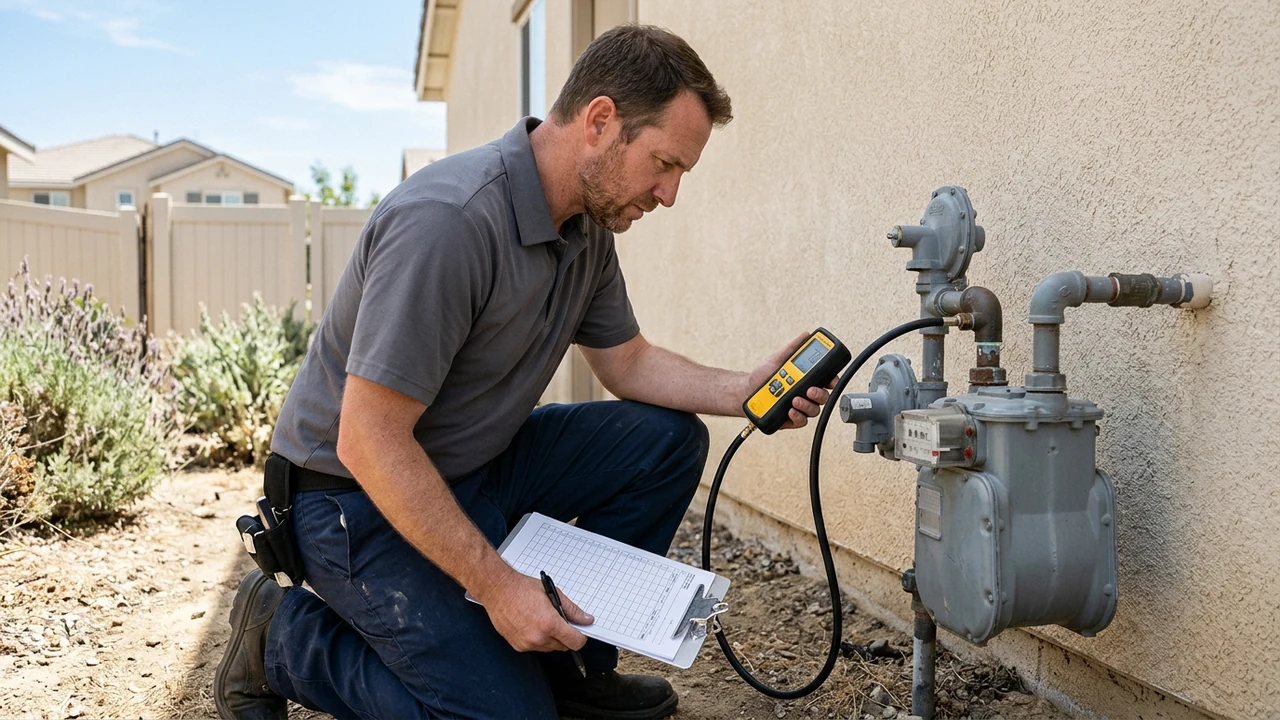
Our technicians begin with an industrial-grade heated-diode or infrared electronic combustible gas analyzer featuring a flexible gooseneck probe. Unlike home alarms that require heavy gas accumulation, professional sniffers detect methane concentrations as low as 5 to 10 parts per million (PPM). We methodically scan every accessible appliance control valve, sediment trap, flare union, CSST manifold, meter riser, and wall penetration to isolate immediate active plumes.
Stage 2: Hydrostatic / Pneumatic Manometer Pressure Drop Testing
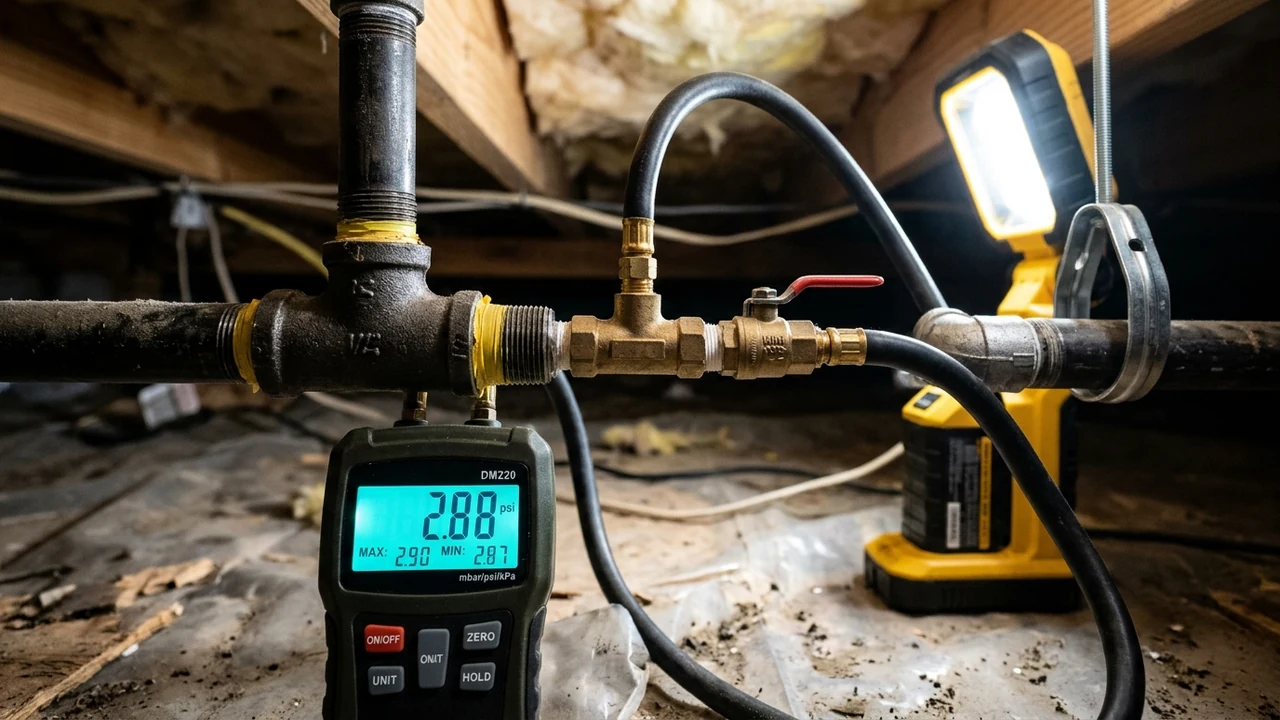
To test the 80% of your gas piping hidden behind walls, ceilings, and floors, we isolate the gas distribution system by closing the main meter supply valve and capping appliance outlets. We then attach a calibrated digital or water-column manometer gauge (or code-compliant low-pressure test gauge) to pressurize the closed piping network with air or inert test gas.
By monitoring the digital pressure reading down to 0.01 PSI over a timed stabilization window, the manometer reveals with 100% mathematical certainty whether the piping system holds tight. Even a pinhole corrosion leak hidden inside a second-story floor joist cavity will register an unmistakable pressure decay curve on the gauge.
Stage 3: Zone Isolation and Ultrasonic / Non-Corrosive Micro-Bubble Pinpointing
If the manometer confirms a pressure drop, our plumbers isolate individual branch runs (such as the kitchen range line, the attic furnace run, the garage water heater, or an exterior pool heater line) to narrow the leak to the exact section of pipe. We then use high-viscosity, non-corrosive commercial leak-detection fluids and ultrasonic acoustic sensors to pinpoint the exact failing fitting or corroded pipe thread without unnecessary demolition.
Stage 4: Appliance Regulator Pressure & Combustion Safety Audit
A comprehensive gas inspection also verifies that your system is operating at the proper dynamic flow pressure – typically 7 inches of water column (WC) on the supply side and 3.5 to 4 inches WC at the appliance manifold. We inspect for required sediment traps (drip legs) ahead of furnaces and water heaters, verify earthquake shutoff valve operation, and check flue drafting to ensure zero carbon monoxide spillage.
Specific Gas Piping Vulnerabilities in Pittsburg & East Contra Costa Homes
- Expansive Delta Soil Movement: Homes near the Pittsburg waterfront and foothills experience seasonal soil heave that stresses underground exterior gas risers and yard lines serving detached garages or pool equipment.
- Unbonded Yellow CSST Tubing: Many homes remodeled between 1995 and 2012 contain early-generation yellow Corrugated Stainless Steel Tubing (CSST) that requires proper electrical bonding to prevent arcing damage.
- Recalled or Outdated Brass Appliance Connectors: Uncoated brass flex connectors from decades past suffer from solder-joint embrittlement and must be upgraded to modern coated stainless steel connectors whenever an appliance is moved.
Frequently Asked Questions
If PG&E shuts off and locks my gas meter due to a leak, how do I get gas service restored?
When PG&E detects a house-side gas leak, they will shut off and red-tag the meter for safety. To restore service in Pittsburg, CA, you must hire a licensed plumbing contractor to locate and repair the leak, pull a municipal plumbing permit if required, pass a pressure test inspection verifying the system holds zero pressure drop, and clear the system for utility turn-on.
How often should a residential gas line system be inspected?
Even if you never smell gas, a preventative gas safety inspection should be performed every 2 to 3 years, prior to purchasing an older home in East Contra Costa County, or immediately following any noticeable earthquake.
