
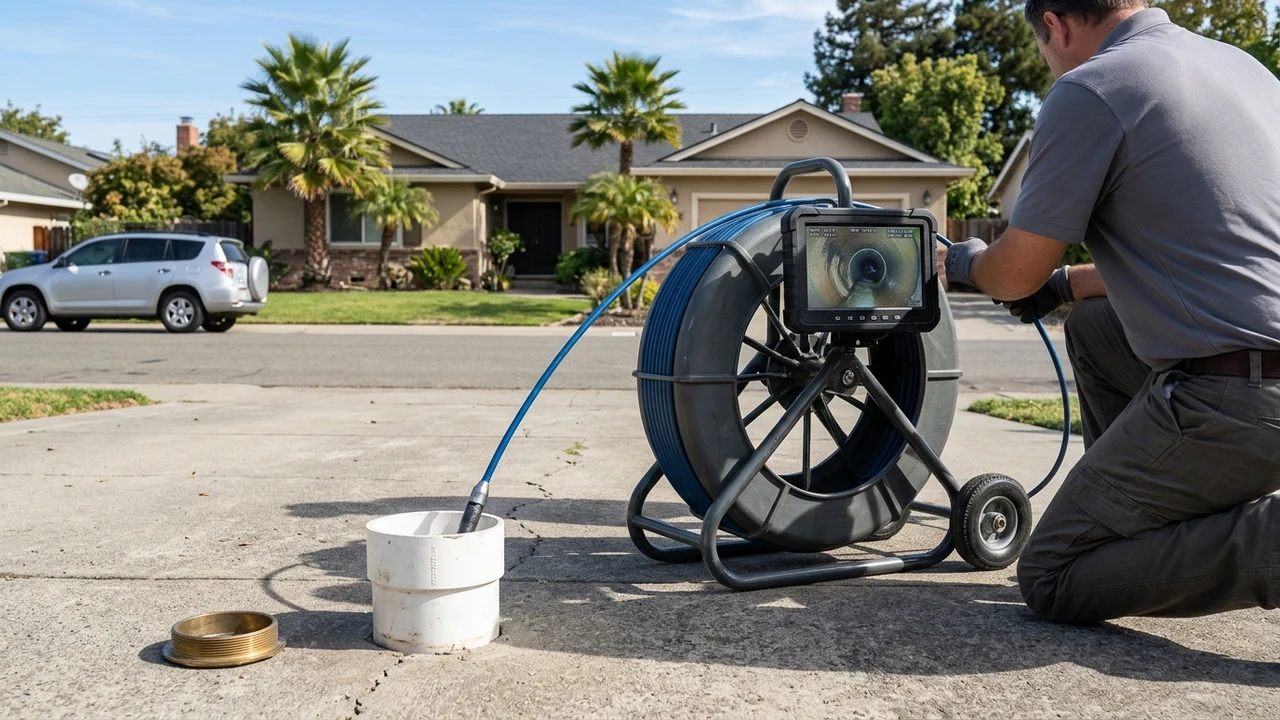
For most homeowners in Pittsburg, California, underground sewer pipes remain completely out of mind until wastewater begins backing up into shower basins or foul odors drift across the front lawn. Because residential sewer lateral lines lie buried three to eight feet beneath driveways, walkways, and mature landscaping, diagnosing underground drainage failures requires specialized diagnostic engineering rather than destructive trench excavation.
Whether you are purchasing an older home near Old Town Pittsburg, dealing with recurring toilet gurgles in the Highlands, or managing slow drains throughout your property, scheduling a professional sewer line evaluation is the definitive first step. Rather than relying on guesswork or chemical drain openers, a certified diagnostic evaluation utilizes high-resolution fiber-optic video equipment to inspect every linear foot of your sewer lateral from foundation footing to municipal main connection.
Understanding what actually occurs during a professional sewer evaluation – the diagnostic steps, specialized optical instruments, pipe defect classifications, and resulting engineering assessments – empowers homeowners in Pittsburg and East Contra Costa County to protect their plumbing infrastructure and avoid unnecessary excavation costs.
The Primary Diagnostic Objectives of a Sewer Line Evaluation
A comprehensive sewer line assessment is not merely a quick peek inside a dirty pipe. Licensed plumbing professionals approach an evaluation with specific diagnostic objectives designed to establish the structural integrity, hydraulic capacity, and operational lifespan of your underground drainage system.
1. Identifying Hidden Structural Fractures and Joint Separations
Many residential properties across Pittsburg and neighboring East Contra Costa communities were constructed with vitrified clay pipe (VCP) or cast iron lateral lines. Over decades of ground vibration, seismic settling, and natural soil movement, rigid pipe sections shift out of alignment. A visual video inspection identifies microscopic hairline cracks, severe radial fractures, offset pipe collars, and dropped joints where raw sewage escapes into surrounding soil.
2. Auditing Invasive Tree Root Penetration
Pittsburg’s warm climate and expansive root systems of mature oak, willow, and ficus trees pose constant hazards to subterranean plumbing. Thirsty tree root filaments detect microscopic vapor leaks escaping from loosened pipe hubs. Once inside, root hairs feed on moisture and nutrient-rich organic waste, rapidly expanding into dense, interlocking root masses that capture toilet paper and grease. A professional inspection pinpoints the exact entry point and radial volume of root intrusion.
3. Detecting Pipe Sags, Bellies, and Negative Slope Gradient
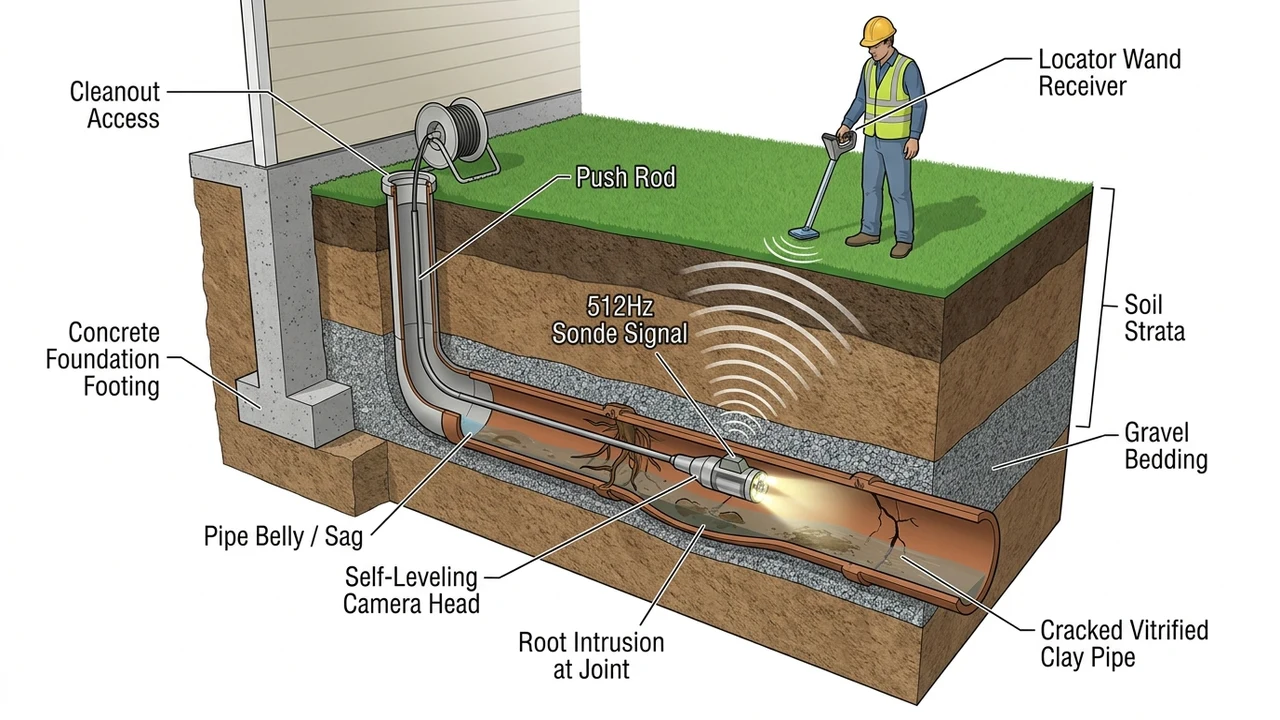
Gravity is the sole driving force behind residential sewer drainage. A properly engineered sewer lateral maintains a uniform downward pitch – typically one-quarter inch of fall per linear foot. When underlying soil consolidates or erodes, pipes develop depressions known as “bellies.” Wastewater pools in these low sections, creating dead zones where solid waste settles, decelerates hydraulic flow, and triggers recurrent mainline blockages.
4. Evaluating Material Degradation and Scale Accumulation
Older cast iron sewer mains suffer from interior tuberculation and channeling – chemical corrosion that forms jagged, crusty iron oxide deposits along pipe interior walls. A video evaluation measures the extent of interior pipe narrowing, scouring wear, and bottom channel degradation to determine if mechanical descaling or trenchless pipe relining is necessary.
Step-by-Step Walkthrough: What Happens During the Inspection
When a certified A1 Phoenix Plumbing technician arrives at your Pittsburg property to conduct a sewer lateral evaluation, the process follows a rigorous multi-stage diagnostic protocol.
Phase 1: Locating and Accessing the Sewer Cleanout Riser
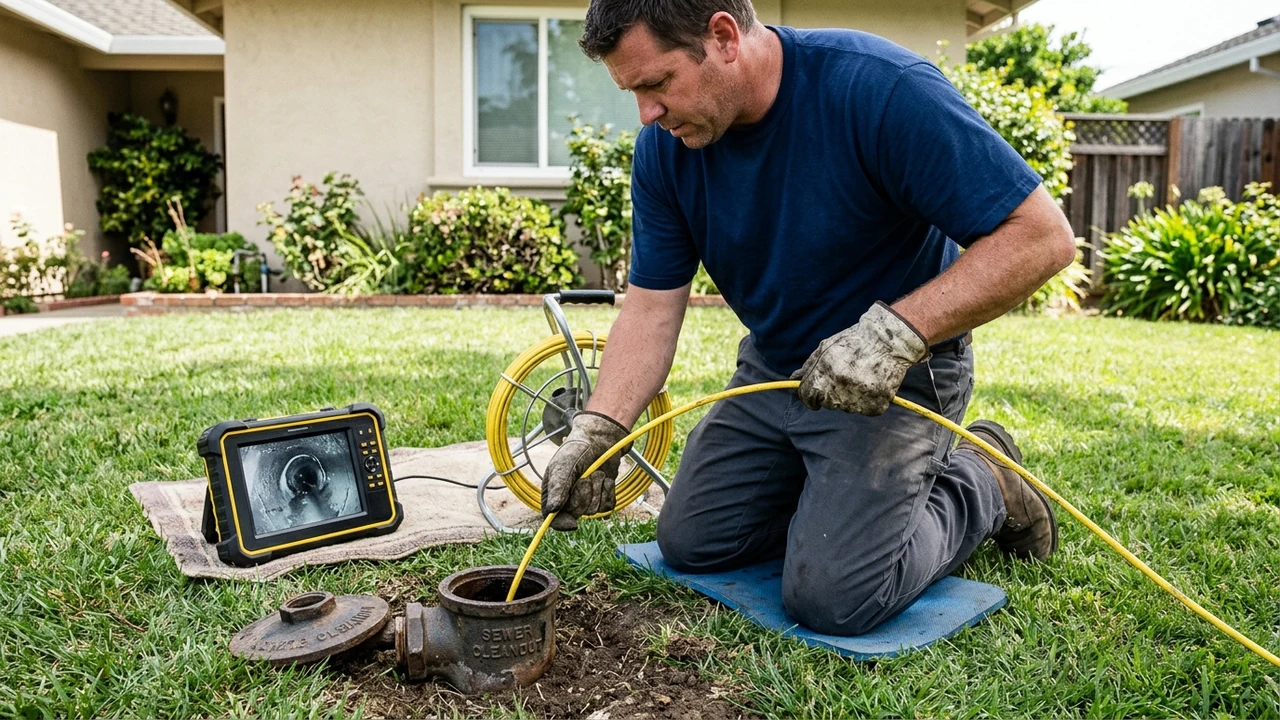
The evaluation begins by locating the primary exterior sewer cleanout riser. This threaded access point, typically four inches in diameter, is situated outside near the home’s foundation footing, in a ground-level valve box on the front lawn, or adjacent to the driveway. If an exterior ground-level cleanout is unavailable, technicians can access the line through a rooftop plumbing vent stack or by temporarily pulling an indoor ground-floor toilet fixture.
Phase 2: Deploying the High-Definition Self-Leveling Camera
Once the cleanout cap is loosened, the technician inserts a specialized self-leveling sewer inspection camera mounted on a rigid yet flexible fiberglass push-rod. These industrial camera heads are engineered with high-intensity LED illumination arrays and sapphire crystal scratch-resistant lenses, capturing high-definition color footage inside damp, zero-visibility subterranean environments.
The self-leveling optical gyroscope ensures the camera picture remains perfectly upright regardless of push-rod rotation, allowing the operator and homeowner to distinguish the pipe crown (top) from the pipe flowline (bottom) in real time.
Phase 3: Real-Time Sonde Electromagnetic Locating
Modern diagnostic sewer cameras house an internal 512 Hz radio transmitter known as a sonde. As the camera navigates through the underground lateral, an operator above ground uses a handheld digital locator wand. By tracking the radio frequency emitted by the camera head, the plumber maps the exact geographical path of the sewer pipe across your front yard, pinpointing structural defects down to the exact inch and determining depth beneath the surface.
This precision locating eliminates blind digging, ensuring that if localized spot repairs or cleanout installations are required, excavation is confined strictly to a small, targeted square footage of turf or concrete.
Phase 4: Running Flow Tests and Water Volume Verification
During the scope, the technician frequently turns on indoor fixtures or runs an outdoor hose down the cleanout. Introducing water flow allows the technician to evaluate hydraulic performance in action. Water reveals the true water level line, verifies whether proper drainage slope exists, and exposes subtle back-pitch areas where water pools rather than draining steadily toward the municipal main.
Phase 5: Digital Archiving and Comprehensive Report Delivery
Upon completing the full lateral run to the municipal city sewer tap, the technician compiles a comprehensive diagnostic evaluation report. The inspection footage is digitally recorded and archived, providing homeowners and prospective home buyers with full video documentation, timestamps, linear foot measurements, and an objective breakdown of pipe conditions.
Common Subterranean Findings in Pittsburg and Contra Costa Properties
Decades of residential plumbing service across Pittsburg, Antioch, and Oakley reveal distinct localized drainage conditions:
- Expansive Clay Soil Shifting: Soil conditions in East Contra Costa County expand during winter rain cycles and contract during hot, dry summer months. This cyclical ground heave places continuous shear stress on rigid sewer joints, causing offset pipe sections.
- Vitrified Clay Joint Fractures: Neighborhoods developed in the mid-20th century frequently feature clay sewer tiles connected with mortar or tar seals. Roots aggressively seek out these degraded joints, breaking pipe bells.
- Grease and Biofilm Buildup: Years of kitchen cooking oil and soap scum coat lateral walls in a dense gelatinous layer, catching hair and flushable wipes that restrict hydraulic flow.
- Foreign Object Blockages: Non-dispersible wipes, dental floss, children’s toys, and heavy paper products lodged in low-flow sections or caught on internal pipe burrs.
Evaluation Outcomes: Understanding Recommended Remediation Pathways
An honest, professional sewer evaluation concludes with clear, actionable recommendations tailored to the specific defects uncovered during the scope:
1. Preventative Hydro Jetting Scour
If the camera reveals heavy grease accumulation, soft organic clogs, or light root hair intrusions in an otherwise structurally intact PVC or clay pipe, high-pressure hydro jetting is the premier recommendation. Pressurized water streams up to 4,000 PSI scour pipe walls down to bare substrate and flush debris completely into the city main.
2. Trenchless CIPP Epoxy Pipe Relining
When an existing lateral exhibits hairline cracking, minor root entry at joints, or pinhole cast iron channeling but remains structurally round and properly graded, trenchless cured-in-place pipe (CIPP) lining provides a seamless, structural epoxy sleeve inside the old host pipe without digging up lawns or concrete driveways.
3. Localized Spot Repair or Cleanout Addition
When damage is isolated to a single crushed joint or cracked section beneath a lawn, precision sonde locating enables targeted excavation to replace just the compromised segment with durable Schedule 40 PVC and install a two-way cleanout riser for future maintenance access.
4. Full Lateral Replacement via Pipe Bursting
In instances of catastrophic pipe collapse, severe reverse slope, or severely degraded Orangeburg/decayed cast iron, hydraulic pipe bursting pulls a new seamless high-density polyethylene (HDPE) lateral directly through the old pipe path with minimal surface disruption.
Frequently Asked Questions
How long does a professional sewer camera evaluation take?
A standard residential sewer camera evaluation in Pittsburg typically takes between 45 and 90 minutes. This includes locating access points, performing the video scope from home to city sewer connection, sonde electromagnetic depth tracing, and reviewing findings on the monitor with the homeowner.
Can a sewer camera break through a complete line blockage?
No. A sewer camera is a delicate, precision optical diagnostic tool, not a mechanical cutting snake. If a sewer lateral is completely backed up with standing opaque blackwater or a dense root plug, the camera lens will be blinded. Technicians must first clear an opening using a mechanical snaking auger or hydro-jetter before performing the camera scope.
Do I need a sewer inspection before buying a house in Pittsburg, CA?
Yes, absolutely. Standard home inspections do not cover subterranean sewer lateral lines; they merely run water in sinks to see if drains operate at that moment. A dedicated sewer camera inspection reveals hidden collapsed pipes, extensive root intrusions, and off-grade bellies that can cost upwards of $10,000 to $25,000 in unforeseen post-purchase repair bills.
How often should homeowners schedule a preventative sewer evaluation?
For homes older than 25 years or properties with large trees planted within 20 feet of the front yard sewer path, scheduling a preventative camera evaluation every 18 to 24 months is ideal. Catching minor root intrusions and joint fractures early prevents catastrophic emergency backups into home living spaces.
