
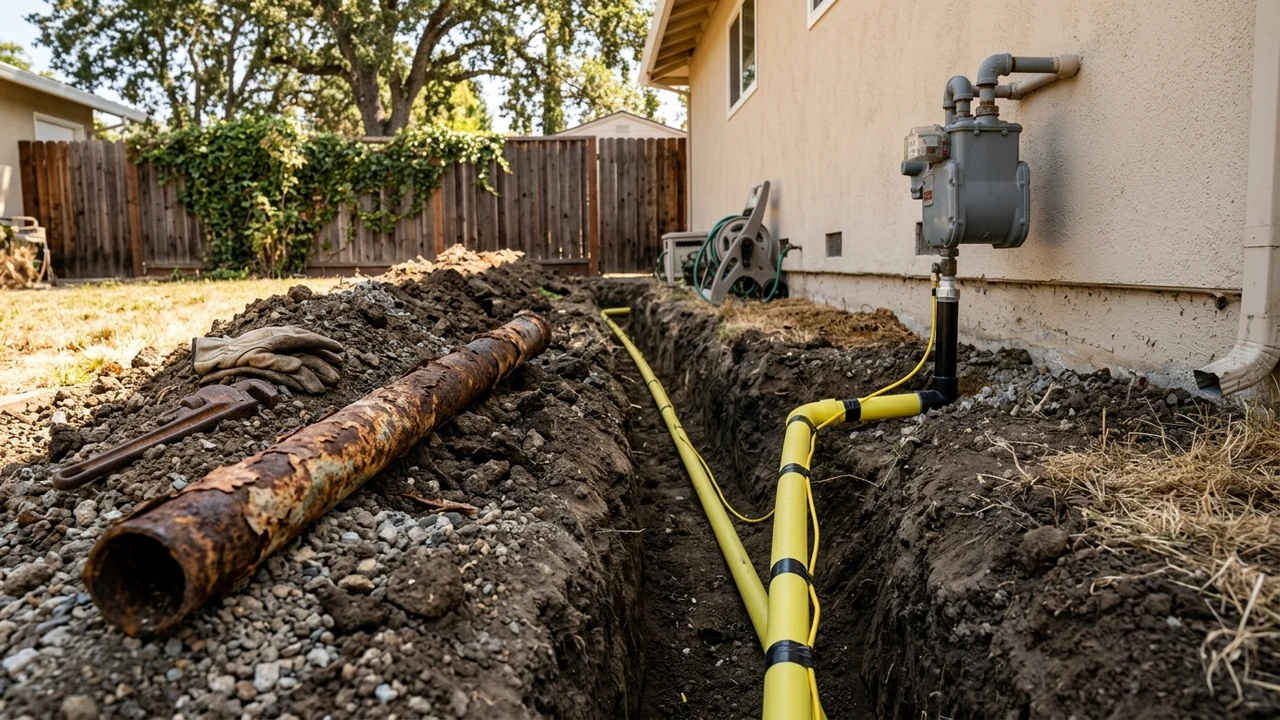
When a professional pressure test or electronic leak inspection reveals a defect in your property’s natural gas piping in Pittsburg, CA, the immediate priority is shutting off the compromised zone to protect the building and its occupants. Once the immediate hazard is isolated, however, property owners face a major technical and financial decision: gas line repair vs. repiping: what factors can influence the recommendation?
In some cases, an isolated leak at a single appliance union or exterior meter riser can be resolved quickly and economically with a targeted sectional repair. In other cases – particularly in older East Contra Costa County homes with corroded underground steel piping or undersized branch manifolds – performing spot repairs on a deteriorating system is a temporary band-aid that leads to repeat leaks, failed municipal inspections, and escalating labor bills. Here is how licensed plumbing specialists at A1 Phoenix Plumbing evaluate the mechanical condition of your gas network in Pittsburg, Antioch, Oakley, and Brentwood to provide an honest, code-compliant recommendation.
When Targeted Gas Line Repair Is the Right Engineering Choice
A localized gas line repair involves isolating the damaged fitting, valve, or short pipe segment, removing the defective component, installing new schedule-40 black iron, coated steel, or approved PE/CSST fittings, and pressure-testing the line. Spot repair is typically the ideal recommendation when four conditions are met:
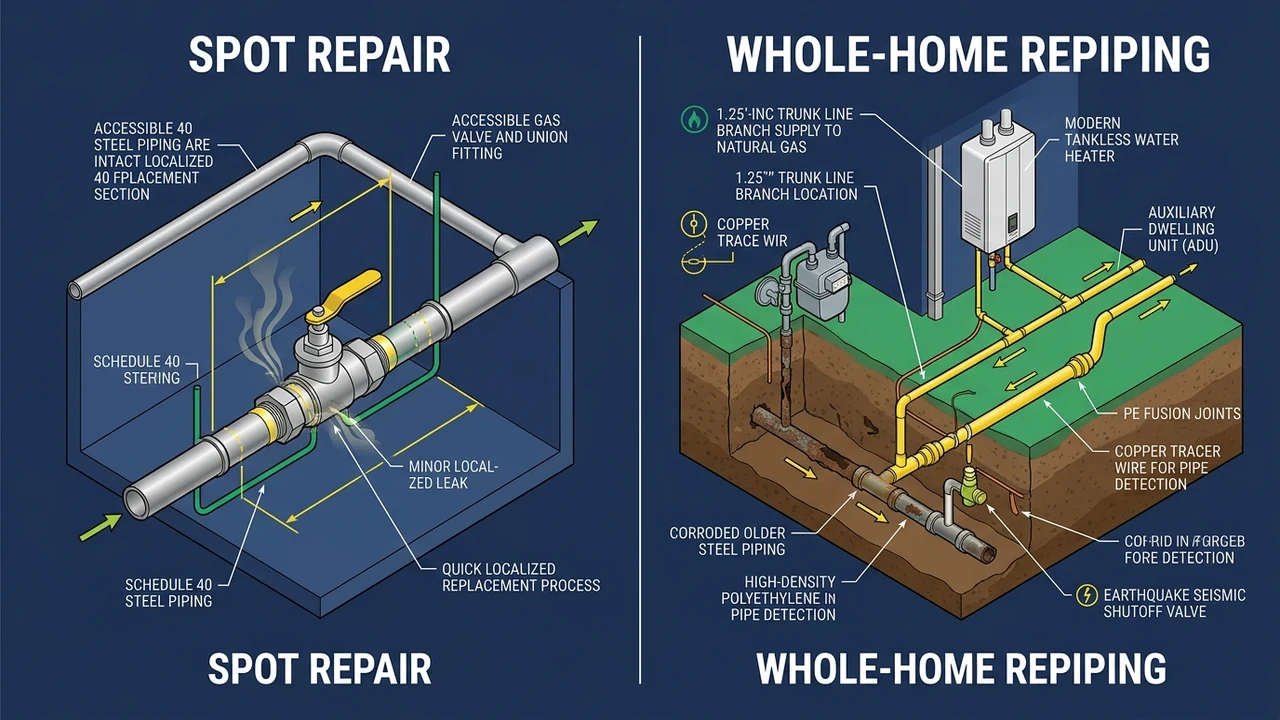
- Isolated Mechanical Damage or Single-Fitting Seepage: The leak is confined to a single accessible location – such as a dried-out thread sealant joint on a water heater tee, a worn brass appliance shutoff valve, or an exterior riser nicked by landscaping equipment.
- Sound Surrounding Pipe Wall Integrity: Ultrasonic wall-thickness checks and visual inspection of the adjacent black iron or copper/PE piping show clean, unpitted metal with sharp, intact threads and zero flaking rust scale.
- Single Pressure Drop Zone: When the repaired section is capped and tested with a calibrated manometer, the remainder of the house piping holds 100% steady pressure with zero secondary micro-leaks.
- Adequate Pipe Sizing (BTU Capacity): The existing pipe diameter meets current California Plumbing Code sizing tables for all connected gas appliances without starving burners at peak load.
7 Critical Factors That Point Toward Gas Line Repiping
When a licensed Pittsburg plumber recommends partial or whole-system gas line repiping rather than a patch repair, that recommendation is driven by specific mechanical, safety, and building-code realities.
1. Widespread Corrosion and Pitting on Underground Steel Pipes
Many mid-century homes in Pittsburg, CA were built with threaded galvanized or bare black steel gas lines buried directly in East Contra Costa County’s moisture-retentive clay soil, or running through damp, poorly ventilated crawlspaces. Over 30 to 50 years, electrochemical soil reaction eats away the pipe wall from the outside in. If your buried yard line or under-house main shows heavy exfoliating rust, flaking scale, or multiple pinhole leaks during a manometer test, threading new pipe onto rotted, brittle metal is impossible – the old pipe walls simply crush under a pipe wrench. Repiping with modern fusion-welded yellow polyethylene (PE) underground piping or coated overhead piping provides a permanent 50+ year solution.
2. Multiple Leaks Detected Across Different Branch Lines
Under municipal building codes in Pittsburg and Contra Costa County, when a gas system is opened for major repair after a utility lock-off, the entire distribution system must pass a pressurized air test (typically 10 to 15 PSI for 15 minutes on standard welded/threaded systems) before the inspector will sign off on a green tag for PG&E meter reconnection. If old pipe compound has dried out and crystallized across ten different T-fittings hidden inside walls, chasing and tearing open drywall at ten separate spots often costs more in labor and restoration than running a clean, continuous new gas manifold through the attic or crawlspace.
3. High-BTU Appliance Upgrades (Tankless Water Heaters, Pool Heaters & ADUs)
A traditional 40-gallon storage tank water heater consumes roughly 36,000 to 40,000 BTUs/hour, easily supplied by a legacy 1/2-inch gas branch line. Modern condensing tankless water heaters, commercial-style 48-inch kitchen ranges, backyard pool heaters, and detached ADUs frequently demand 150,000 to 400,000+ BTUs/hour. Attempting to run high-BTU appliances on undersized 1/2-inch or 3/4-inch piping causes severe dynamic pressure drops, burner lockouts, and incomplete combustion. Repiping with a properly sized 1-inch or 1.25-inch trunk line or a parallel manifold ensures every appliance receives steady manifold pressure simultaneously.
4. Presence of Compromised or Unbonded Legacy CSST
If your property contains early-generation thin-walled flexible gas tubing that has suffered kinking, rodent damage, or electrical arcing perforations in the attic, replacing the compromised run with code-compliant black iron or properly bonded arc-resistant jacketed tubing is essential for fire safety.
5. Concealed Threaded Unions Inside Inaccessible Slabs or Walls
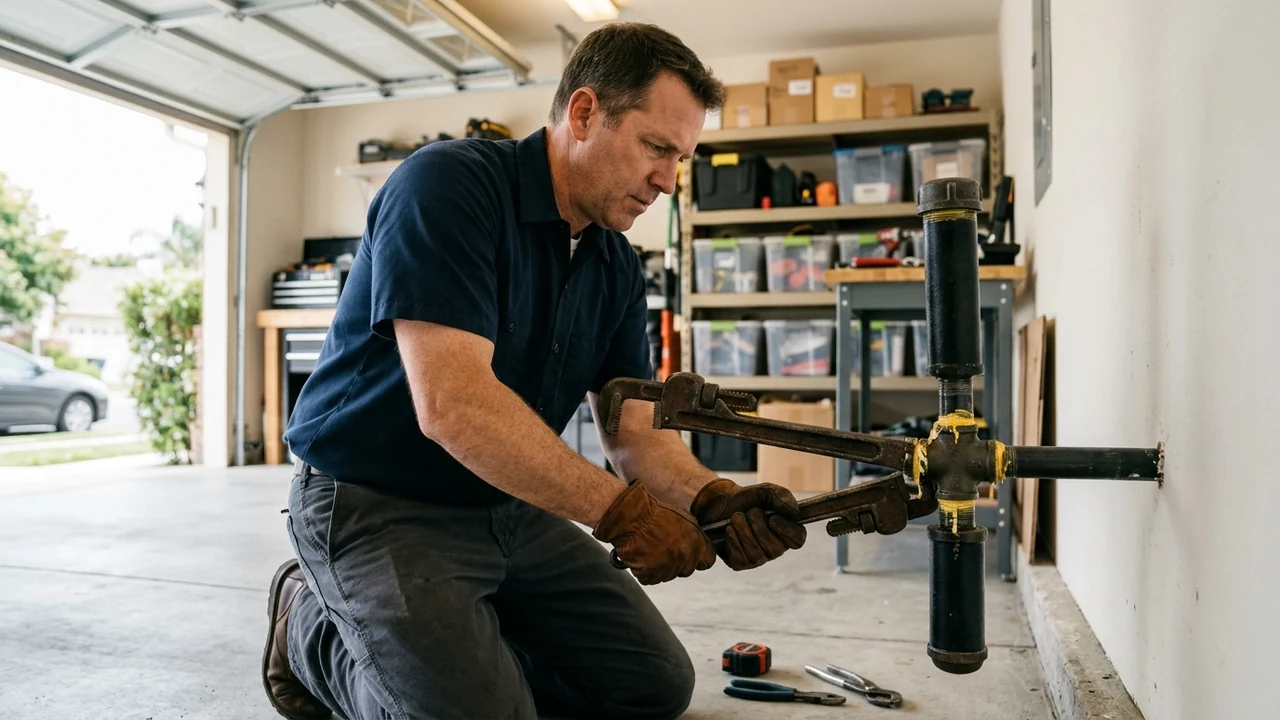
California Plumbing Code strictly prohibits concealed mechanical unions or unapproved fittings buried inside concrete slabs without protective sleeving and venting. When a sub-slab gas line develops a leak beneath a Pittsburg home’s living room floor, jackhammering through hardwood flooring and concrete foundation is rarely necessary – instead, we abandon and cap the leaking sub-slab line and reroute a brand-new code-compliant gas line through the attic or exterior perimeter.
Comparison Overview: Gas Line Repair vs. Gas Line Repiping
- Project Timeline: Localized gas line repairs are typically completed in 2 to 4 hours; whole-home gas repiping or underground yard main replacements generally take 1 to 2 days including municipal pressure inspection.
- Materials Used: Above-ground interior/crawlspace networks utilize durable Schedule 40 Black Iron or arc-resistant CSST manifolds; underground exterior lines utilize corrosion-proof High-Density Polyethylene (HDPE) gas pipe with anodeless transition risers and tracer wire.
- Long-Term Value: Spot repair resolves an immediate single-point defect; whole-line repiping eliminates aging pipe corrosion, increases BTU capacity for future renovations, and includes modern safety upgrades like seismic shutoff valves and appliance sediment traps.
Frequently Asked Questions
Do I need a city building permit for gas line repiping in Pittsburg, CA?
Yes. Any new gas line installation, underground main replacement, or repiping after a utility meter shutoff in Pittsburg, CA requires a municipal plumbing permit and a witnessed manometer/gauge pressure test by the city building inspector before PG&E will unlock and restore gas flow.
Why must a tracer wire be buried alongside a new underground plastic (PE) gas pipe?
Because yellow polyethylene gas pipe is non-metallic and cannot corrode in damp Pittsburg soils, a corrosion-resistant 14-gauge or 12-gauge copper tracer wire is buried directly alongside the pipe and brought up at the risers. This allows utility locators to electromagnetically trace the exact underground path of the gas line before any future yard excavation.
