
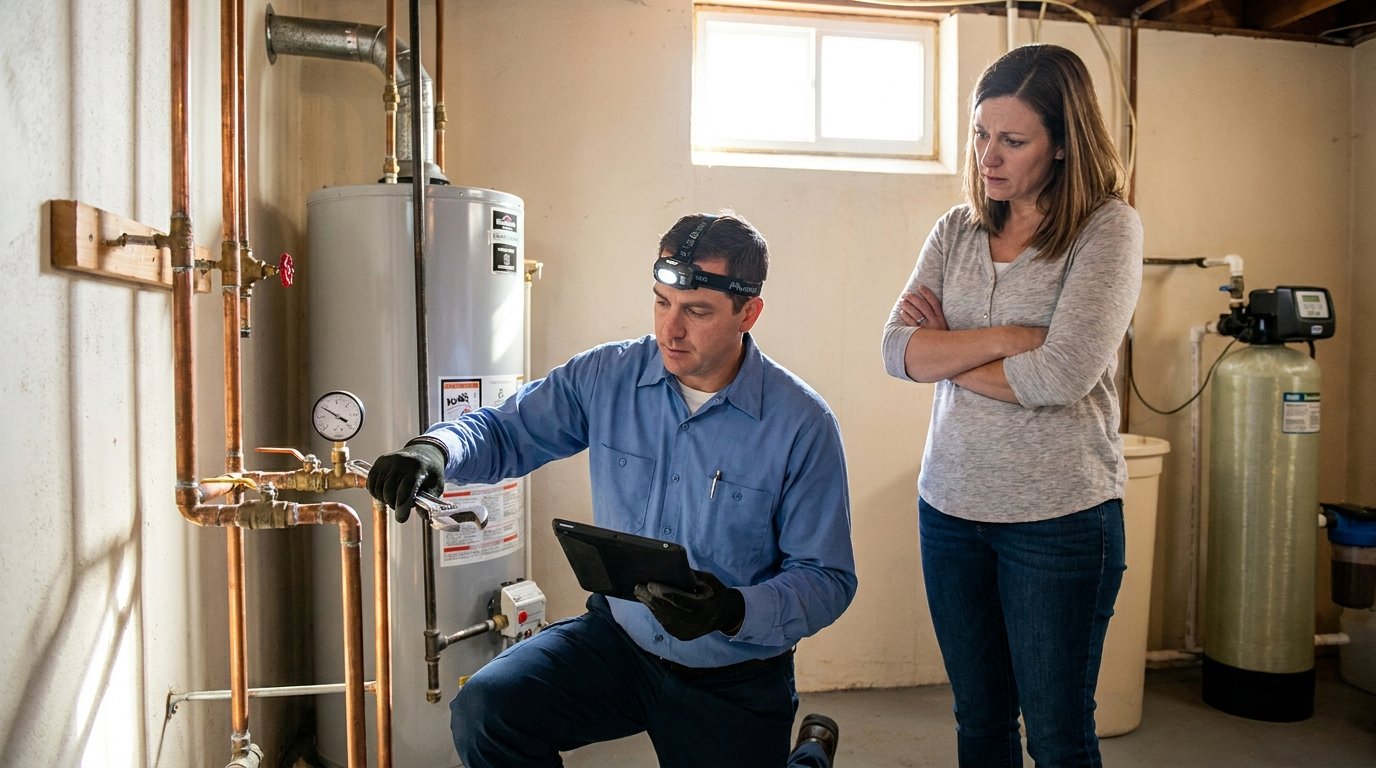
You turn on the shower and the water just dribbles out. The kitchen tap feels weak. Even the toilet takes forever to refill. When water pressure drops all over the house at once, something bigger is going on than one bad faucet. The good news? Most causes are known, findable, and fixable once you know where to look.
What Does Low Water Pressure Actually Mean?
Let me keep this simple. Water pressure is the push that moves water through your pipes. We measure it in PSI, which stands for “pounds per square inch.” Think of it like the strength of a person pushing water through a straw. More push means a stronger stream.
Most homes run best between 40 and 60 PSI. Plumbing code in most areas caps the top end at about 80 PSI to protect your pipes and appliances. When your whole house sits below 40 PSI, showers feel weak and appliances struggle. In our experience on service calls, about 8 out of 10 “weak water” complaints trace back to pressure that has slipped under that 40 mark.
There is one more word you should know: flow rate. Flow rate is how much water comes out over time, measured in gallons per minute (GPM). Pressure is the push. Flow is the amount. You can have low flow at a single tap while the rest of the house is fine. That difference matters a lot, and I will show you why in the next part.
Here is a quick way to picture normal versus weak pressure at home:
| Pressure Reading (PSI) | What It Feels Like | What It Usually Means |
|---|---|---|
| 60–80 PSI | Strong, full stream | Normal to high; watch the top end |
| 45–60 PSI | Comfortable, steady | Healthy range for most homes |
| 30–40 PSI | Weak showers, slow fill | Low; worth checking soon |
| Below 30 PSI | Trickle, long waits | A real problem; needs diagnosis |
Whole-House Drop vs. One Bad Faucet
In my professional experience, the first thing I check on any low-pressure call is whether the problem is everywhere or just one spot. This one step saves hours. It tells me if I am hunting for a big supply issue or a small clog at a single tap.
Here is the simple test. Walk your home. Turn on the cold water at the kitchen sink, then the bathroom sink, then the shower, one by one. Notice which ones feel weak. If only one fixture is slow, the trouble is likely local, like a clogged aerator or a bad supply valve. If every fixture is weak, the problem sits upstream, closer to your main shut-off valve, your pressure regulator, or the water line itself.
Roughly 7 out of 10 single-tap complaints we see are just a clogged aerator or a gunked-up cartridge. Those are cheap, fast fixes. A whole-house drop is a different animal. It points to shared parts that feed the entire home, and that is where careful diagnosis pays off.
Use this quick checklist to sort it out before you do anything else:
- One faucet weak, rest fine? Clean the aerator or check that fixture’s shut-off valve.
- Only hot water weak everywhere? Suspect your water heater or a hot-side clog.
- Both hot and cold weak everywhere? Look at the main valve, the PRV, or the supply line.
- Weak only in the morning or at night? Could be municipal supply demand or a shared line.
- Pressure dropping slowly over months? Think corrosion or mineral buildup inside pipes.
Sorting your home into “one spot” versus “everywhere” is the single most useful thing you can do first. Get this right, and you have already done half a plumber’s job.
The Most Common Causes of Low Water Pressure in the Whole House
When pressure falls across the whole house, the cause is almost always on this list. I will walk through each one in plain words so you can spot the signs at home.
Clogged Pipes and Mineral Buildup
Over years, minerals from your water stick to the inside of pipes. This is called scale. It is mostly calcium and magnesium left behind by hard water. Little by little, the pipe opening gets smaller. Less room means less water, and your pressure fades so slowly you may not notice until it is bad.
Homes with hard water build scale much faster. In areas with heavy minerals, I have opened pipes that had lost nearly half their inside space to crusty buildup. That kind of narrowing chokes flow through the entire system, not just one tap.
Corroded or Old Galvanized Pipes
If your home was built before the 1970s, it may still have galvanized steel pipe. These pipes rust from the inside out. The rust flakes and swells, and the opening shrinks. Corrosion is one of the most common reasons older homes lose pressure everywhere at once. If your water sometimes looks brown or rusty, old pipe is a strong suspect.
A Failing Pressure Regulator
Your pressure regulator, also called a PRV (pressure reducing valve), controls how hard water pushes into your home. When it fails, it can send too little pressure to every tap. A bad PRV is sneaky. It can drop your whole house at once, and folks often blame the city or their pipes when the real problem is this one small part.
Hidden Leaks and Slab Leaks
Water that escapes before it reaches your taps is water you never get to use. A hidden leak inside a wall, under the floor, or beneath the concrete (called a slab leak) steals pressure from the whole house. You might see a wet spot, hear running water, or watch your water bill climb for no clear reason.
Water Heater Sediment
If only your hot water is weak, look at the water heater. Sand-like sediment settles at the bottom of the tank and can block the outlet. This chokes hot-water flow to every faucet and shower. It also makes the heater work harder and wear out faster.
Municipal Supply or Shared Line Issues
Sometimes the problem is not inside your home at all. The municipal supply may run low during busy hours, or a shared line with neighbors may be undersized. If your pressure sags at the same time every day, the city side is worth a look.
A Partly Closed Main Valve
This one is almost funny because it is so common. After a repair, someone forgets to fully open the main shut-off valve or the meter valve. A half-closed valve strangles your whole house. It is the first thing a smart plumber checks, and I have fixed “big pressure problems” in ten seconds by simply turning a handle all the way open.
Here is a fast way to match what you feel with the likely cause:
| Symptom | Likely Cause | Where It Sits |
|---|---|---|
| Slow drop over months, everywhere | Scale or corrosion in pipes | Inside your pipes |
| Sudden drop, whole house | Failing PRV or main valve | Near the meter/main |
| Only hot water weak | Water heater sediment | At the tank |
| Weak at set times daily | Municipal supply demand | City side |
| Wet spots, high bill, weak flow | Hidden leak or slab leak | Under floor/walls |
| Brown water plus weak flow | Old galvanized pipe | Whole system |
The Pressure Regulator: The Part Most People Forget
I have handled cases exactly like this before: a family spends money replacing faucets and cleaning aerators, and nothing helps, because the real problem was a PRV quietly failing behind the scenes. This little brass part does big work, and when it goes, the whole house feels it.
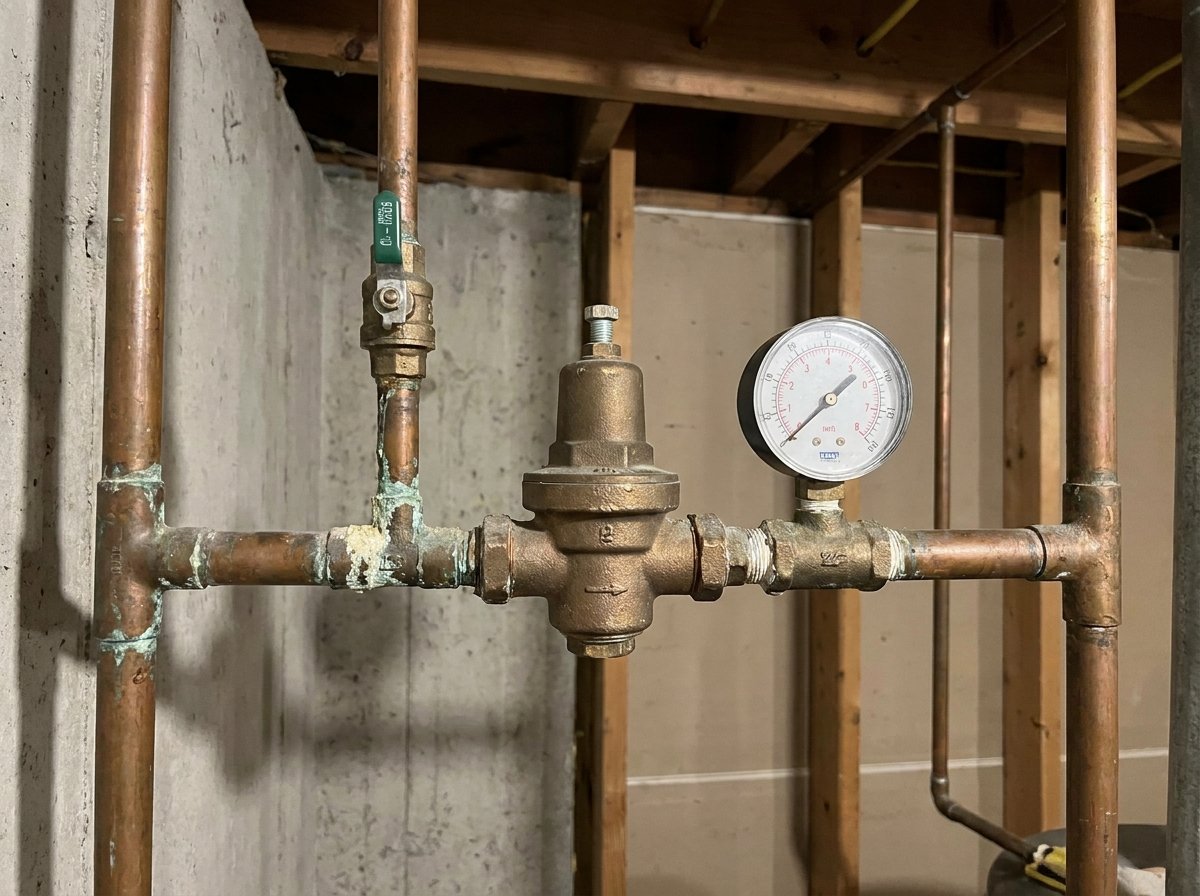
Your pressure regulator usually sits where the main water line enters your home, often near the main shut-off valve. Its job is to take the strong pressure from the street and knock it down to a safe 40 to 60 PSI for your house. When the internal spring or seal wears out, it can choke flow to a trickle or, on the other end, let dangerous high pressure through.
Most regulators last around 10 to 15 years before they start to fail. If yours is older than that and your whole house feels weak, it is a prime suspect. The tricky part is that a failing PRV mimics other problems, so people chase the wrong fix for weeks.
Signs your PRV may be the culprit include weak pressure at every tap, pressure that swings high and low for no reason, and a banging or hammering sound in the pipes. A plumber can test this fast with a gauge. If your regulator is the problem, replacing it is a targeted repair, not a whole-home job, which is a relief for your wallet.
How Hard Water Slowly Chokes Your Pipes
Hard water is water packed with minerals. It feels fine to drink, but it leaves trouble behind. Every time hard water flows through your pipes, it drops tiny bits of calcium and magnesium on the walls. Over time, those bits harden into scale, and scale is the enemy of good flow.
The buildup is slow, so most people miss it. You will not wake up one day to a clogged pipe. Instead, your pressure fades a little each year until showers feel weak and filling a pot takes forever. Fixtures with small openings, like showerheads and aerators, clog first because scale plugs the tiny holes.
The white, crusty spots on your faucets and glass are the same stuff building up out of sight. If you see heavy spotting, your pipes are likely collecting scale too. A water softener removes those minerals before they reach your pipes, which protects your flow for the long run. If your water leaves crusty white spots and your pressure keeps sliding, our water softener installation can stop scale before it chokes your lines.
For homes already dealing with heavy buildup, a softener alone may not undo years of damage inside the pipes. In bad cases, sections of pipe need replacing. Our team can check your flow and tell you honestly whether a softener is enough or whether professional water line services are the smarter path. Straight answers save you money.
Simple Checks You Can Do Before You Call
I have seen this pattern many times in my work: a homeowner panics, but the fix turns out to be something they could have spotted in five minutes. Before you pay anyone, run these easy checks yourself. They cost nothing and often point straight at the problem.
Start with your main shut-off valve and your water meter valve. Make sure both are turned all the way open. A partly closed valve is one of the most common causes of weak flow, and it is free to fix. Next, unscrew the aerator on a weak faucet and look for grit or scale. Rinse it, clear the screen, and screw it back on.
According to the U.S. Environmental Protection Agency’s WaterSense program, the average American family uses more than 300 gallons of water per day at home, and roughly 70 percent of that is used indoors (EPA WaterSense). With that much water moving through your pipes daily, even a small blockage or leak shows up fast in how your fixtures perform.
Here is a simple leak test the EPA recommends. Check your water meter, then do not use any water for two hours. Check the meter again. If the number moved, you likely have a hidden leak somewhere in the system. The EPA notes that household leaks waste nearly 1 trillion gallons of water nationwide each year, and the average home loses about 9,300 gallons annually to leaks (EPA WaterSense). Fixing easy leaks can trim a water bill by around 10 percent.
Run through this quick DIY list before calling a pro:
- Open every valve fully — the main shut-off and the meter valve.
- Clean your aerators and showerheads of scale and grit.
- Do the two-hour meter test to check for hidden leaks.
- Check for wet spots on floors, walls, and ceilings.
- Test both hot and cold at several taps to map the problem.
- Look at your PRV gauge if one is installed near the main.
If you do all this and pressure is still weak everywhere, the problem is deeper. That is the point where a professional gauge test and trained eyes earn their keep.
How a Pro Finds the Real Problem
A good plumber does not guess. We test. The first move is a pressure gauge screwed onto an outside hose spigot or the laundry tap. This gives a hard number in PSI. If it reads below 40 PSI, we know the whole system is starved and we start tracing why.
Next comes a flow test. Pressure and flow rate tell different stories, so we measure both. A home can show okay pressure at rest but poor flow when taps open, which points to narrowed or scaled pipes. This is where knowing your GPM matters. For reference, the EPA reports that standard showerheads flow at 2.5 gallons per minute, while water-saving models use no more than 2.0 GPM (EPA WaterSense). If your shower falls far below even the low end, flow is being lost somewhere.
From there, we narrow it down. We test the PRV with the gauge. We inspect visible pipe for corrosion. We check the water heater for sediment if only hot water is weak. For hidden trouble, we use leak-detection gear and cameras to find leaks inside walls or under the slab without tearing up your home. If we suspect a buried leak, targeted slab leak detection pinpoints the spot before any digging starts.
Here is how the do-it-yourself approach compares with a professional diagnosis:
| Step | DIY Check | Professional Diagnosis |
|---|---|---|
| Pressure reading | Guess from feel | Exact PSI with a calibrated gauge |
| Flow measurement | Hard to judge | Measured GPM at multiple taps |
| Hidden leaks | Two-hour meter test | Acoustic and camera leak detection |
| Pipe condition | Look at exposed pipe | Camera inside walls and under slab |
| PRV health | Rarely checked | Direct gauge test and inspection |
The difference is certainty. A pro turns “I think it might be the pipes” into “your PRV is set at 22 PSI and needs replacing.” That saved guesswork means you fix the right thing the first time.
Repair or Replace? How to Think About the Fix
In my professional experience, the biggest money mistakes happen when people replace the wrong thing. They rip out good pipe when a PRV swap would have solved it, or they keep patching leaks in pipe that should be fully replaced. The right call depends on what the diagnosis actually shows.
Some fixes are small and targeted. A failing pressure regulator, a clogged aerator, or a stuck main valve are quick, low-cost repairs. Others are bigger. Whole-home corrosion in old galvanized pipe usually means repiping, because patching one rusted section just moves the problem down the line. Around 8 out of 10 homes we repipe still had original steel pipe from decades ago.
If your home still runs on old galvanized pipe and pressure keeps fading, our water line repiping team can look at it and give you a straight answer on repair versus full replacement. No pressure, no scare tactics.
For hot-water-only problems, a flush or a repair often beats replacing the whole tank. If sediment is the issue, timely water heater repair can restore flow and add years of life to the unit. Here is a simple way to think about it:
| Problem Found | Usually a Repair | Usually a Replace |
|---|---|---|
| Failing PRV | ✔ Swap the valve | Rare |
| Clogged aerators | ✔ Clean or replace part | No |
| Water heater sediment | ✔ Flush or repair | Only if tank is old/rusted |
| One leaking section | ✔ Patch that spot | If pipe is widely corroded |
| Whole-home galvanized rust | Patching wastes money | ✔ Repipe the system |
When Low Water Pressure Turns Into an Emergency
Most pressure problems are slow and annoying, not urgent. But some are true emergencies, and knowing the difference protects your home. If pressure drops to almost nothing all at once, that sudden change often points to a burst pipe or a major hidden leak dumping water where you cannot see it.
Watch for these warning signs that mean act now, not later:
- Sudden total pressure loss across the whole house with no known cause.
- Water pooling on floors, in the yard, or seeping through a ceiling.
- The sound of running water when every tap is off.
- A water bill that jumps sharply with no change in your habits.
- Warm spots on the floor, which can signal a hot-water slab leak.
A slab leak is one of the worst, because water runs under your concrete foundation and can cause real structural harm over time. The faster it is found, the less damage it does. When pressure vanishes suddenly or you see water where it should not be, do not wait for business hours. Our emergency plumbing help is a call away, and fast action keeps a leak from turning into a flood.
Honestly, the homeowners who act quickly almost always spend less. A leak caught in an hour is a small repair. The same leak ignored for a week can mean ruined flooring, mold, and a much bigger bill.
The Bottom Line
Low water pressure across the whole house is almost never random. It is your plumbing telling you something specific: scale is building, a PRV is failing, pipes are corroding, or water is leaking out of sight. The trick is reading the signs right before you spend money on the wrong fix.
Start simple. Check your valves, clean your aerators, and run the two-hour meter test. If pressure is still weak everywhere, that is your cue to bring in a pro with a real gauge and the tools to find the true cause. Fixing the right thing once beats guessing five times.
Have you noticed your pressure slipping lately? Map your home first, run the easy checks, and you will already know more than most. And when the problem sits deeper than a quick fix, the right diagnosis is what gets your strong, steady water back for good.
Frequently Asked Questions
1. Why does my water pressure drop only in the morning?
This usually points to your municipal supply, not your home. When your whole neighborhood showers and runs appliances at the same time, city pressure sags. If it recovers by midday, the city side is the likely cause. If it stays weak all day, the problem is inside your home, like your PRV or your pipes.
2. Can a clogged pipe really lower pressure in the whole house?
Yes. When scale or corrosion narrows a main line that feeds your home, every faucet downstream loses flow. Hard water speeds this up by leaving mineral deposits on the pipe walls. The buildup is slow, so pressure fades over years until it becomes hard to ignore.
3. How do I know if my pressure regulator is bad?
Watch for weak pressure at every tap, pressure that swings high and low, or banging sounds in the pipes. Most regulators last 10 to 15 years. A plumber can confirm it in minutes with a pressure gauge. A bad PRV is a targeted fix, so you do not need to replace pipes to solve it.
4. Is low water pressure ever dangerous?
Low pressure itself is not dangerous, but the cause can be. A sudden drop can mean a burst pipe or a slab leak quietly damaging your foundation. If you see water pooling, hear running water with taps off, or watch your bill spike, treat it as urgent and call for help fast.
5. Should I fix low water pressure myself or call a plumber?
Try the easy stuff first: open all valves fully, clean the aerators, and run the meter test for leaks. Those solve many single-tap problems for free. If your whole house is still weak, call a pro. A gauge test finds the real cause so you fix the right thing the first time.
