
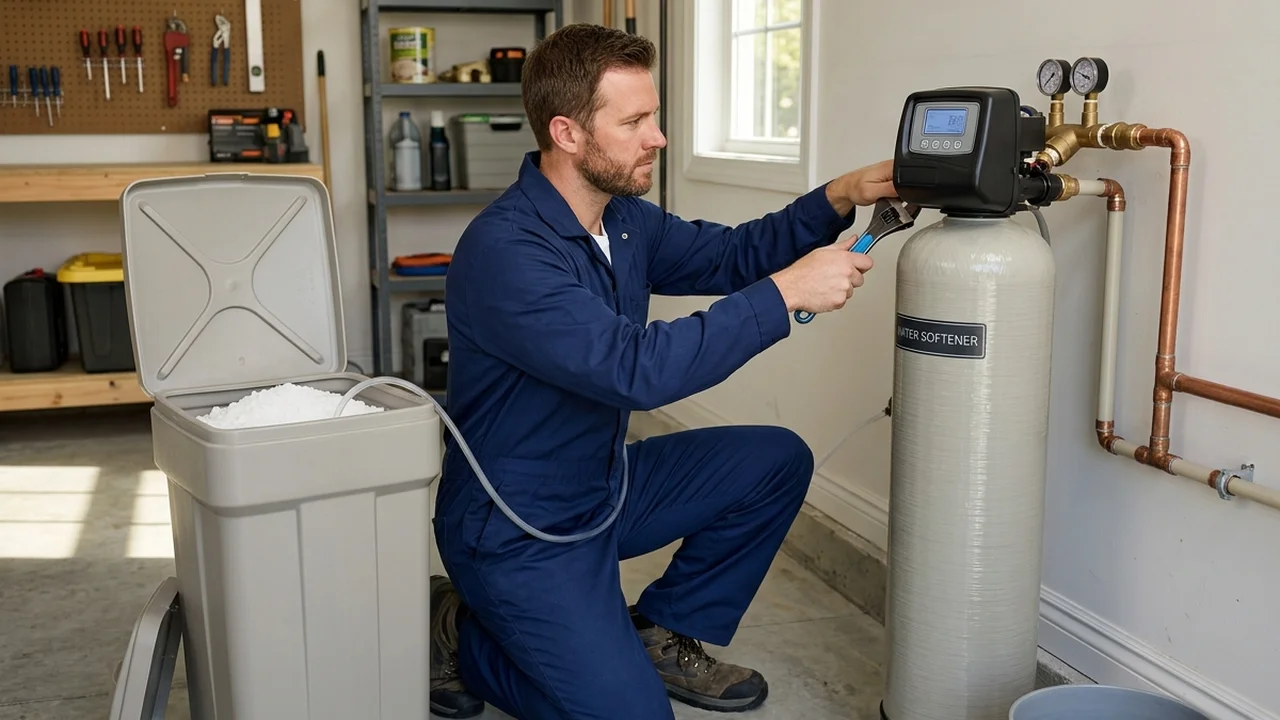
Your water softener works quietly in the background every single day. You forget it’s even there. Then one morning your soap won’t lather, white spots show up on your glasses, and your skin feels a little sticky after a shower. That’s the moment most people start asking one simple question: does this thing need a professional, or can I fix it myself?
I’ve worked on these systems for years, and here’s the honest truth. Most softener problems start small and quiet. A little salt bridge here. A skipped regeneration there. A well-kept unit can run strong for 10 to 15 years, but a neglected one can fail in half that time. The real skill is knowing which jobs are safe to do yourself and which ones need a trained hand and the right tools.
What Does a Water Softener Actually Do?
A water softener takes the hard minerals out of your water. That’s the short version. Hard water is full of calcium and magnesium, and those minerals leave chalky buildup on your pipes, your faucets, and your dishes. Your softener swaps those minerals for a tiny bit of sodium, and the water that comes out feels smooth and clean.
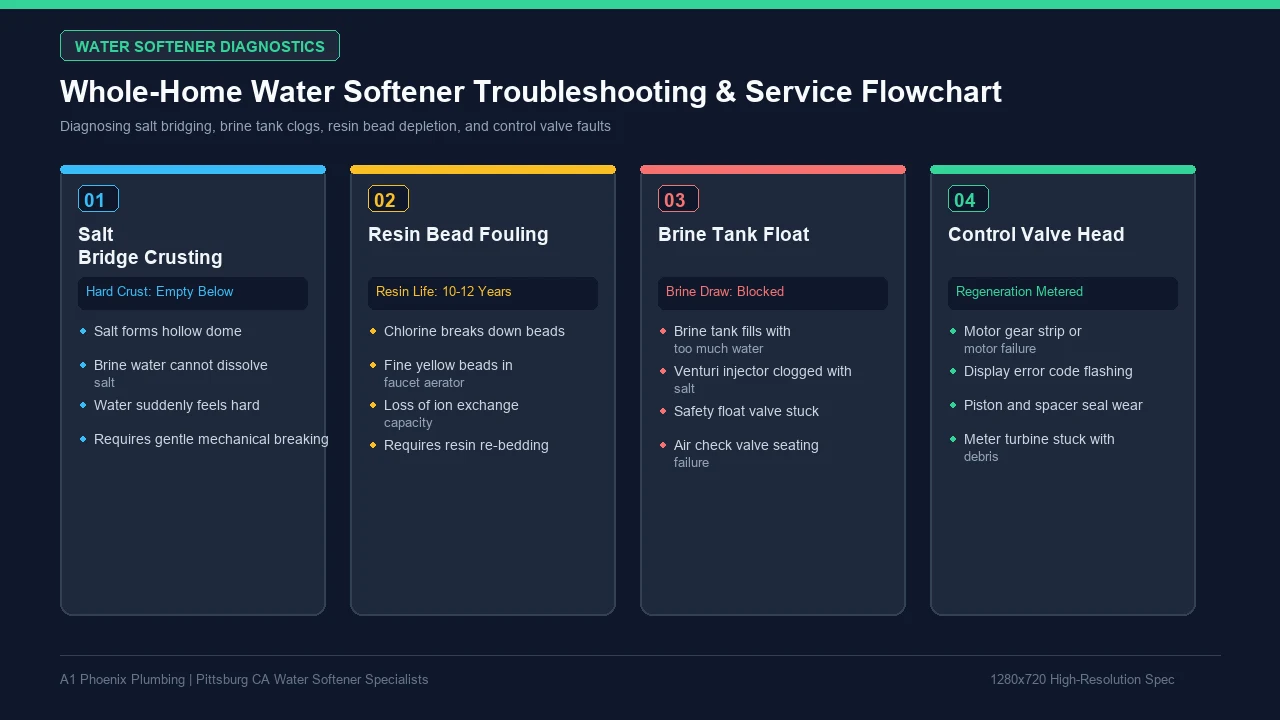
The whole job happens inside a tank full of small plastic beads called resin. Water flows through the beads, and the beads grab the hardness minerals like a magnet. After the beads get full, the system runs a cleaning cycle called regeneration, usually every 3 to 7 days. During this cycle, salty water from the brine tank rinses the beads and washes the minerals down the drain.
The simple science of soft water
Think of the resin beads like a sponge. A sponge can only soak up so much before it’s full. Once it’s full, you have to squeeze it out to use it again. That squeeze is regeneration, and the salt is what makes the squeeze work. Most home softeners hold enough resin to soften water for a family of four for 6 to 7 days before they need to clean themselves.
Here’s a key point many homeowners miss. The salt you pour in does not soften your water directly. It only cleans the beads so they can keep working. If you understand that one idea, you already know more about your softener than most people on your street.
Warning Signs Your Water Softener Needs Professional Service
In our field work, folks wait far too long to call for help. They notice a small problem, shrug, and hope it goes away. It rarely does. I’ve handled cases where a simple valve adjustment would have cost very little, but the homeowner waited months and ended up needing a full rebuild. Catching warning signs early can save you real money and stress.
Your softener talks to you, in its own quiet way. It uses your water, your pressure, and even your utility bills to send signals. The trick is learning to read them. Most serious repairs I see could have been caught weeks earlier if the owner knew what to look for.
Here are the most common signs that your system needs professional attention:
- Hard water is back. You see spots on glasses, and soap won’t lather like it used to.
- Salty-tasting water. This often means the brine valve is stuck open during regeneration.
- Unusual noises. Loud gurgling, banging, or constant running points to a valve or motor problem.
- Low water pressure. A clogged resin bed or filter can choke the flow to your whole home.
- The system never regenerates. If you never hear it run at night, the timer or control board may be dead.
- The system runs all the time. Constant cycling wastes salt, water, and money.
- Rising utility bills. A softener stuck in regeneration can send water straight down the drain.
Let me put the most useful signs in a simple table so you can match your problem to its likely cause. This is the same quick check I run in my head on every service call.
| Warning Sign | What It Usually Means |
|---|---|
| White spots and dull dishes | Resin is worn out or system isn’t regenerating |
| Salty water | Stuck brine valve or wrong salt setting |
| Unusual noises at night | Failing valve, motor, or air in the lines |
| Low water pressure | Clogged resin bed, filter, or iron buildup |
| Softener runs nonstop | Broken timer, stuck valve, or leak |
| Higher utility bills | Water wasted during a failed regeneration cycle |
One more sign to watch is time itself. If your softener is more than 10 years old and you’re seeing two or three of these problems at once, that’s not a coincidence. That’s an aging unit asking for a checkup. If your water suddenly feels hard again and you can’t spot the cause, our team can run a full system check and test your water so you’re not guessing.
DIY Maintenance vs. Professional Service: Where’s the Line?
Not every job needs a pro. I’ll be the first to tell you that. Adding salt and checking levels are things any homeowner can handle in five minutes a month. But some tasks need special tools, water testing gear, and know-how. Cross that line without training, and you can void your warranty or flood your utility room.
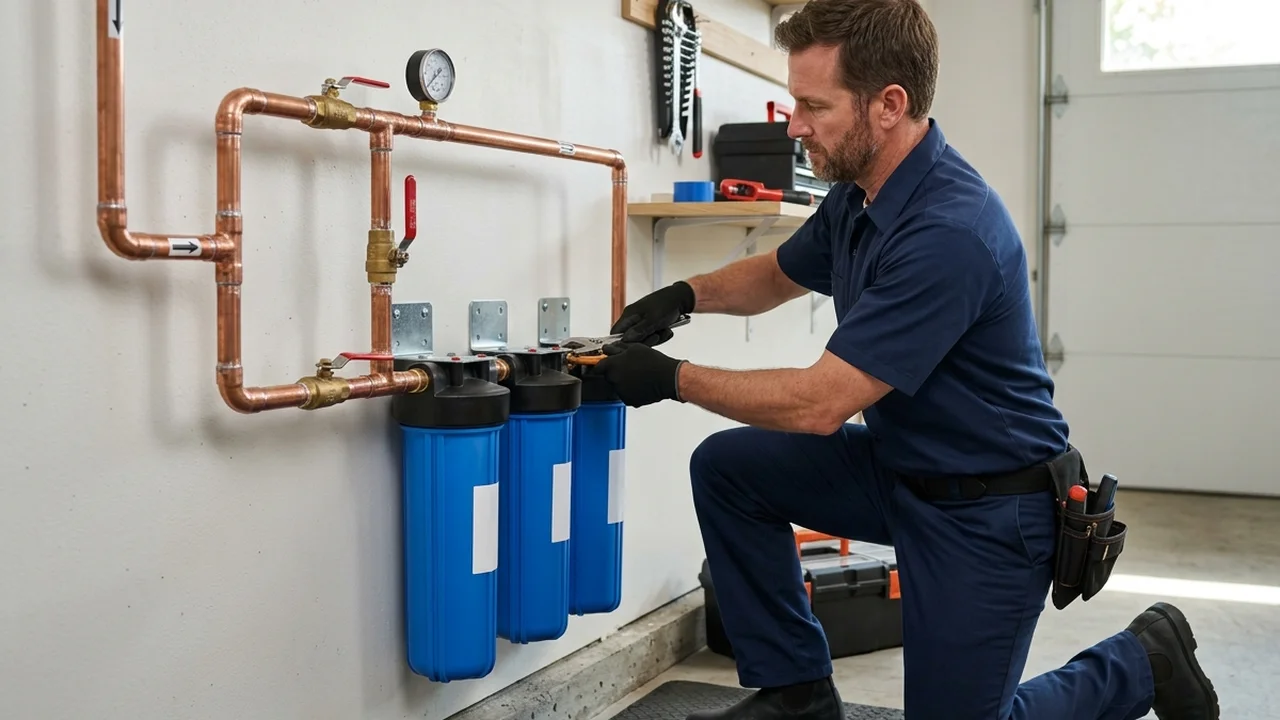
The rule I give my own clients is simple. If the job is about salt, cleaning, or looking for leaks, do it yourself. If the job touches the control valve, the resin bed, or the electronics, call a professional. Roughly 8 out of 10 service calls I get could have been avoided with basic monthly care, but the other 2 truly needed trained hands.
Here’s a clear split of who should do what:
| Task | Do It Yourself | Needs a Professional |
|---|---|---|
| Add salt to the brine tank | Yes | , |
| Check salt level monthly | Yes | , |
| Break up a salt bridge | Yes | , |
| Clean the brine tank yearly | Yes | , |
| Replace the resin beads | , | Yes |
| Fix or replace the control valve | , | Yes |
| Adjust hardness and cycle settings | Sometimes | Yes |
| Diagnose pressure or motor issues | , | Yes |
Notice the middle ground on settings. You can often change a basic hardness number yourself, but getting it exactly right needs a real water test. Set it too low and your water stays hard. Set it too high and you waste salt and money every week. A pro measures your true hardness first, then dials in the specific number your system needs.
How Often Should You Service a Water Softener?
I’ve seen this pattern many times in my work: the homeowners who set a simple schedule almost never call me for emergencies. The ones who “wait until something breaks” call me at the worst possible time, usually on a holiday weekend. A little regular care goes a long way, and the schedule is easier than most people think.
Good maintenance happens in layers. Some checks are monthly. Some are quarterly. And one deep service should happen once a year, ideally by a professional. Most quality softeners only need one pro visit every 12 months to stay at peak performance, as long as you handle the small stuff in between.
Here’s the schedule I hand to my clients:
| How Often | Task | Who Handles It |
|---|---|---|
| Monthly | Check salt level, look for salt bridges, scan for leaks | You |
| Quarterly | Clean the brine well, add resin cleaner, test water at home | You |
| Twice a year | Deep-clean the brine tank, check regeneration timing | You or pro |
| Yearly | Full professional service, valve check, resin and hardness test | Professional |
Older systems need a little more love. If your unit is past the 7 to 10 year mark, I’d bump the pro checkups to every 6 months. Parts wear out, seals dry, and the control board slows down. Catching a tired part early is far cheaper than a middle-of-the-night flood.
Don’t forget the small home tasks between visits. A monthly salt check takes two minutes. A quarterly brine-well rinse takes about fifteen minutes. These tiny habits are what keep your softener running effectively all year, and they cost you almost nothing but a bit of time.
Salt and Brine Tank Problems That Signal a Service Call
The brine tank is where most trouble begins. It’s simple, but it’s fussy. Two problems show up again and again: salt bridges and salt mushing. Both stop your softener from making the brine it needs, and both leave you with hard water even though the tank looks full of salt.
A salt bridge is a hard crust that forms across the top of the salt pile. It looks fine from above, but there’s an empty air gap underneath. No salt touches the water, so no brine gets made. You can test for it by gently pushing a broom handle down into the salt. If you feel a hard shelf about halfway down, you’ve found a bridge. Break it up and clear the pieces out.
Salt mushing is the other troublemaker. This is a thick sludge of old salt that settles at the bottom of the tank. It blocks the brine draw and can clog the whole system. In my experience, mushing is far more common with cheap rock salt, which is why I steer clients toward cleaner pellets. Roughly 9 out of 10 mushing cases I open up trace back to low-grade salt.
Watch for these brine tank warning signs:
- Water sitting on top of the salt for days without dropping
- A hard crust you can tap and hear a hollow sound under
- Thick, muddy sludge at the bottom of the tank
- Hard water returning even with a full-looking tank of salt
- A strong, stale smell from the tank
If you break a bridge and your water still feels hard, that’s your cue to call a professional. It usually means the problem moved deeper, into the brine line or the valve. If you’re not sure whether it’s a simple salt fix or something bigger, we can inspect the tank and valve and give you a straight answer.
Water Pressure Drops and Resin Bed Issues
I’ve handled cases exactly like this before, where a family blamed the city for “bad water pressure” when the real culprit sat right in their garage. A softener with a clogged resin bed acts like a kink in a hose. It quietly chokes the flow to your whole home, and the drop happens so slowly that nobody notices until showers turn weak.
Your resin beads don’t last forever. Iron, sediment, and chlorine wear them down over time. Quality resin lasts 10 to 15 years, but well water high in iron can cut that life in half. When the beads break down, you get low pressure, tiny particles in your water, and shorter stretches of soft water between regeneration cycles.
Your water hardness also decides how hard your resin has to work. The harder your water, the faster the beads fill up and the more often the system must clean itself. The U.S. Geological Survey sorts water into clear bands, and knowing your band helps you plan service. According to the U.S. Geological Survey’s guide on water hardness, water is “hard” at 121 to 180 mg/L of calcium carbonate and “very hard” above 180 mg/L.
Here’s how those levels line up with what you’ll actually notice at home:
| Hardness Level | Calcium Carbonate (mg/L) | What You’ll See |
|---|---|---|
| Soft | 0 – 60 | No spots, easy lather |
| Moderately hard | 61 – 120 | Light film, small spots |
| Hard | 121 – 180 | Clear spots, dull dishes |
| Very hard | 180+ | Heavy scale, fast buildup |
If your home sits in the “very hard” band, your resin works overtime, and it will wear out sooner. That’s a specific case where a yearly professional check really pays off. A pro can measure the beads’ health and tell you if you’re heading for a replacement before your water goes fully hard again.
Seasonal Care: Winter Freezing and Your Softener
Cold weather changes the game. If your softener sits in a garage, a shed, or an unheated basement, winter is its most dangerous season. Water inside the tank and lines can freeze solid. Frozen water expands, and that pressure can crack the tank, split a line, or ruin the control valve in a single cold night.
Seasonal care matters more than most people expect. In colder regions, I tell clients to keep the softener area above 40 degrees Fahrenheit whenever they can. Even a small space heater or a bit of pipe insulation can save you a repair bill that runs into the hundreds. Freezing damage is one of the few problems that can total a healthy unit overnight.
Summer brings its own issues. Higher water use means more regeneration cycles, which means you burn through salt faster. Many families use nearly twice the salt in July than they do in January. So check your brine tank more often during warm, busy months, and don’t let it run dry during a heat wave when you need soft water most.
Before the first hard freeze, run through this quick seasonal checklist:
- Insulate any exposed pipes near the softener
- Keep the room above 40°F with heat or insulation
- Top off the salt so the unit works through cold snaps
- If you travel, set the unit to vacation mode or shut the water
- Look for early cracks or leaks before they spread
Older Systems: When Repair Isn’t Worth It
In our field work, there’s a point where fixing an old softener stops making sense. I’ve seen people pour money into a 15-year-old unit, one repair at a time, until they’ve spent more than a new system would have cost. Knowing when to stop repairing and start replacing is one of the smartest money moves a homeowner can make.
Age and performance tell the story. A softener that keeps its efficiency protects your whole home, from your pipes to your water heater. A U.S. Department of Energy – archived Battelle study measured how much scale buildup hurts appliances, and after heavy buildup, gas water heater efficiency gradually declined about 5%. A dying softener quietly lets that scale creep back into your home.
Here’s the simple decision guide I use on older systems:
| Situation | Best Move |
|---|---|
| Unit under 7 years, small part failed | Repair |
| Unit 8 – 12 years, first major issue | Repair, then watch closely |
| Unit 10+ years, repeat problems | Weigh repair vs replace |
| Repair cost over half of a new unit | Replace |
| Cracked tank or freezing damage | Replace |
There’s also a comfort factor. Newer softeners, like modern Soft Pro demand-based units, only clean themselves when needed, which saves salt and water. Older timer models clean on a fixed schedule whether they need it or not. Switching to a smarter unit can trim your salt use and cut water waste on every single cycle.
If you’re staring at an aging softener and can’t decide, get a real diagnosis first. A quick professional inspection of the resin, the valve, and the tank will tell you if you’re looking at a quick fix or a full replacement. That one visit takes the guesswork out of a big decision.
What Happens During a Professional Service Visit
A good service visit is more than a quick look. When I show up, I run a full head-to-toe check on the system, and I test the water going in and the water coming out. That before-and-after test is the only honest way to prove your softener is doing its job. Numbers don’t lie, and they catch problems your eyes can’t see.
The visit follows a clear order. First comes the water test for hardness and iron. Then I inspect the brine tank, break up any salt bridge, and clean out mushing. Next I check the control valve and the regeneration settings, since a wrong setting wastes both salt and water. Salt care matters here: the EPA Water Sense water softener guide advises checking salt levels every 4 to 6 weeks and notes that a typical unit uses 20 to 70 gallons of water per regeneration cycle.
Here’s what a thorough professional service usually covers:
- Full water test for hardness, iron, and clarity
- Brine tank cleaning and salt bridge removal
- Control valve inspection and seal check
- Regeneration cycle timing and salt setting adjustments
- Resin bed health check and filter cleaning
- Leak and pressure check on all connections
The best part of a pro visit is the tune-up on your settings. Small adjustments to your regeneration timing can save a surprising amount of salt over a year. Getting your hardness number exactly right means the system cleans only when it must. That’s how you keep a softener at peak performance without wasting a thing.
How Much Does Professional Water Softener Service Cost?
In our field work, price fear keeps people from calling until it’s too late. So let’s clear the air. Routine service is not expensive, especially next to the cost of scale damage to your pipes and appliances. The units themselves aren’t cheap either, so protecting one you already own just makes sense.
Costs vary by region and by the kind of work you need. A basic yearly checkup sits at the low end. A resin or valve replacement lands higher. To give you a fair picture, a new softener’s hardware alone often runs from a few hundred dollars into the low thousands, so keeping your current unit healthy is usually the cheaper path by far.
Here’s a rough range so you know what to expect:
| Service | Typical Cost Range |
|---|---|
| Yearly checkup and tune-up | Low, routine service fee |
| Brine tank deep clean | Small add-on cost |
| Resin bed replacement | Mid-range repair |
| Control valve replacement | Mid to high repair |
| Full system replacement | Highest, plan ahead |
The smart play is prevention. Spending a little on regular service each year almost always beats a big surprise repair later. Homes that keep up with maintenance tend to get the full 10 to 20 years out of their softeners, while neglected units often quit years early. If you want a clear quote before anything breaks, we can come out, test your water, and show you exactly where your system stands.
The Bottom Line: Don’t Wait for a Breakdown
Your water softener rarely fails all at once. It drops hints. Spots on the glass. A salty taste. Unusual noises at night. Weak pressure in the shower. Learn those signs, handle the small salt and cleaning tasks yourself, and bring in a professional for the deep work once a year.
That simple rhythm is the whole secret. Small monthly checks, a quarterly cleaning, and one solid professional visit each year. Do that, and your softener will quietly protect your home for 10 to 20 years. Ignore it, and you’ll meet me on a holiday weekend with a flooded floor. Which softener owner do you want to be? I’d love to hear how your system is holding up.
Frequently Asked Questions
How often does a water softener need professional service?
Most systems need one full professional service about once a year, or every 12 months. That yearly visit covers a water test, a brine tank cleaning, and a valve and resin check. If your unit is older than 7 to 10 years, or your water is very hard, bump that up to every 6 months. Between visits, you handle the small monthly salt checks yourself.
Can I service my water softener myself?
Yes, for the easy stuff. You can add salt, check levels monthly, break up salt bridges, and clean the brine tank once a year. These tasks are safe and take only a few minutes. But leave the resin beads, the control valve, and the electrical parts to a professional. Roughly 8 out of 10 breakdowns I see could have been avoided with basic home care, so those small habits really matter.
How long does a water softener last?
A well-kept water softener usually lasts 10 to 20 years. The resin beads inside last about 10 to 15 years before they wear out. Regular maintenance is what pushes a unit toward the longer end of that range. Skipping care, using cheap rock salt, or letting the tank freeze in winter can cut that lifespan in half.
Why is my water hard again even though the softener is on?
This is the most common call I get. Usually it’s one of a few things:
- A salt bridge stopping brine from forming
- An empty or nearly empty brine tank
- Worn-out resin beads that can’t hold hardness anymore
- A wrong hardness setting on the control valve
- A stuck valve skipping the regeneration cycle
Start by checking your salt and testing for a bridge. If the water stays hard, it’s time for a professional to look deeper.
Is it worth repairing an old water softener or should I replace it?
It depends on age, cost, and how often it breaks. A unit under 7 years with one small failure is worth fixing. But once a system passes 10 years and needs repeat repairs, the math changes. My simple rule: if a single repair costs more than half the price of a new unit, replace it. A cracked tank or freezing damage almost always means replacement, since those failures rarely come alone.
