

Few plumbing situations cause immediate household stress quite like water backing up into a sink, shower, or toilet. For homeowners in Pittsburg, California, a slow drain or sudden backup raises an urgent question: is this simply an isolated clog in a single fixture, or is the entire home’s drainage network in jeopardy?
Distinguishing between an isolated fixture obstruction and a mainline sewer failure is essential for protecting your property from contaminated blackwater overflow. In East Contra Costa County – where historical neighborhoods near Old Town Pittsburg feature aging clay lateral lines and newer developments in the hills contend with shifting expansive clay soil – drainage symptoms often disguise severe underlying mainline issues. Understanding how licensed plumbers diagnose drain systems helps homeowners make informed, cost-effective decisions before emergency backups occur.
Understanding Residential Drainage Architecture
To evaluate drain issues accurately, homeowners must first understand how wastewater travels through a residential structure. Every plumbing fixture in your home connects to an individual fixture branch drain line, typically ranging from 1.5 inches to 2 inches in diameter for sinks and tubs, and 3 inches for toilets.
These individual fixture branches converge into secondary drain stacks and horizontal building drains hidden beneath floors, within crawlspaces, or encased inside concrete slab foundations. Ultimately, all indoor wastewater routes into the primary building sewer lateral – a 3-inch to 4-inch underground pipe that channels waste out to the City of Pittsburg municipal sewer main beneath the street. When a blockage occurs within an individual branch, only that specific fixture suffers. Conversely, when the primary building drain or municipal sewer lateral chokes, every single fixture upstream is compromised.
Key Indicators of a Single Isolated Drain Clog
An isolated drain clog is confined entirely to one fixture or its immediate branch arm upstream of any shared junction. Identifying an isolated clog prevents unnecessary excavation or widespread panic.
The primary diagnostic characteristics of an isolated fixture issue include:
- Single Point Failure: Water drains slowly or backs up in only one fixture (such as a bathroom vanity or kitchen sink) while all adjacent fixtures drain rapidly and cleanly.
- Absence of Cross-Fixture Reactions: Running the bathroom faucet does not cause water or gurgling sounds in the adjacent shower stall or toilet bowl.
- Localized Obstruction Matter: The stoppage is directly traceable to localized debris, such as hair and soap scum binding inside an under-sink P-trap, or accumulated cooking grease and food particles in a kitchen garbage disposal drain.
- Normal Ground-Level Drainage: Ground-level fixtures – specifically the lowest shower drain or ground-floor toilet – show zero signs of sluggishness or rising sewage when upper-floor fixtures are used.
Critical Warning Signs of a Whole-House Mainline Drainage Problem
When an obstruction forms within the main horizontal sewer line, wastewater has nowhere to discharge into the municipal utility system. As gravity forces incoming water down toward the lowest available exit point, homeowners experience unmistakable whole-house warning symptoms.
Homeowners throughout Pittsburg, Antioch, and Oakley should watch for these decisive mainline warning signs:
- Multiple Fixtures Backing Up Simultaneously: When the main sewer line is obstructed, flushing a second-floor toilet forces wastewater to rise into the ground-floor bathtub or shower pan, which represents the lowest physical opening in the drainage tree.
- Audible Gurgling and Hydrostatic Air Displacement: When trapped air cannot escape through plumbing vent stacks due to a downstream sewer blockage, air bubbles push backward through fixture P-traps, creating loud bubbling or gurgling sounds from nearby toilets and sinks.
- Sewage Smells and Sewer Gas Odors: Foul, sulfurous hydrogen sulfide odors permeating multiple rooms indicate stagnant wastewater accumulating within building drain lines or dry P-traps displaced by sewer pressure.
- Washing Machine Discharge Reactions: When a high-volume residential washing machine pumps out wastewater during its drain cycle, adjacent floor drains, shower pans, or ground-floor toilets bubble violently or overflow with soapy foam.
- Exterior Cleanout Surcharge: Wastewater bubbling out of the exterior threaded cleanout riser located in the front yard or side yard confirms conclusively that the main lateral pipe between the building foundation and the street is completely choked.
Diagnostic Comparison: Single Clog vs Whole-House Sewer Failure
Plumbing professionals utilize systematic symptom evaluation to differentiate fixture clogs from sewer line obstructions:
| Diagnostic Factor | Isolated Fixture Clog | Whole-House Mainline Failure |
|---|---|---|
| Affected Fixtures | Exactly one fixture (sink, tub, or toilet) | Multiple fixtures across multiple rooms or levels |
| Lowest Fixture Impact | No backup in lowest shower or tub pan | Immediate wastewater rising in lowest floor drains |
| Fixture Cross-Reaction | None; running other taps has zero effect | Flushing toilets forces air or water into tubs/sinks |
| Exterior Cleanout | Completely dry inside cleanout riser | Standing wastewater or actively spilling into yard |
| Primary Root Causes | Hair, soap scum, grease, localized object | Tree root intrusion, pipe belly, offset joint, collapse |
| Required Resolution | P-trap cleaning, manual cable snaking | HD sewer camera inspection, hydro jetting, line repair |
Professional Diagnostic Methodology: How Plumbers Find the Root Cause
Experienced plumbers never guess when diagnosing drainage failures. A methodical investigative procedure ensures rapid identification without unnecessary property disruption.
The diagnostic workflow consists of three decisive phases:
- System Hydro-Testing and Fixture Mapping: The technician inspects the home’s plumbing layout, runs diagnostic water loads through upper-level fixtures, and monitors ground-level fixtures to map the exact convergence point where flow restrictions begin.
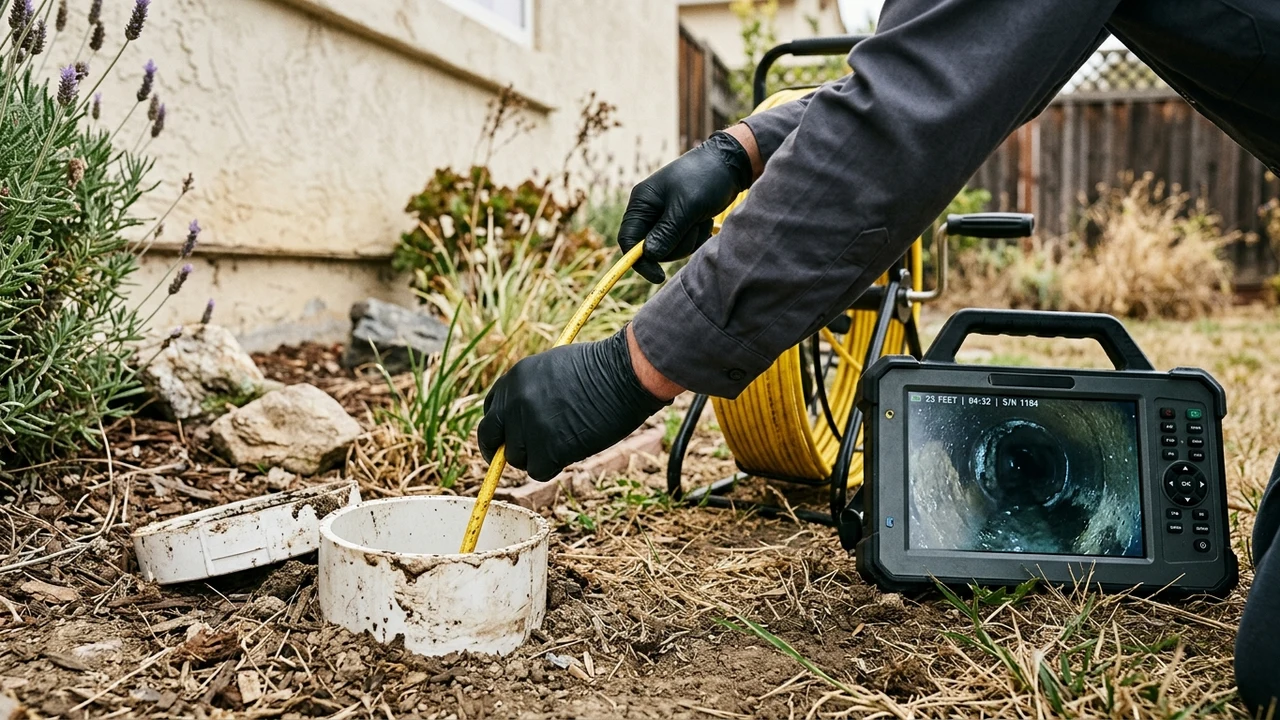
- High-Definition Sewer Camera Inspection: By deploying a self-leveling fiber-optic video camera with integrated 512 Hz sonde transmitter down the exterior cleanout, the plumber visualizes the interior pipe wall in real time. The camera reveals exact pipe material (cast iron, vitrified clay, ABS, or PVC), structural fractures, pipe bellies holding stagnant water, and severe tree root penetration.
- Sub-Surface Electromagnetic Depth Sonde Locating: Utilizing an above-ground digital wand receiver, the plumber precisely pinpoints the camera sonde’s subterranean location, marking the exact depth and physical location of pipe damage in the yard or driveway to eliminate blind digging.
Common Underlying Causes of Sewer Line Obstructions in Pittsburg, CA
Sewer lateral lines in East Contra Costa County are subjected to unique regional soil and environmental stressors that accelerate mainline blockages:
- Aggressive Tree Root Infiltration: Mature oak, eucalyptus, and redwood root systems seek out microscopic moisture vapor along subterranean sewer joints. Once hair-thin roots penetrate clay or cast iron seams, nutrient-rich wastewater fuels rapid root expansion into massive root balls that snare toilet paper and solids.
- Expansive Adobe Clay Soil Movement: The expansive clay soils common throughout Pittsburg and Antioch undergo substantial volumetric expansion during wet winter rains and severe shrinkage during hot, arid summer months. This cyclical ground shifting causes underground sewer pipes to shear, form low bellies, or dislodge at joint connections.
- Corrosion in Aging Cast Iron and Vitrified Clay Pipes: Homes constructed prior to the 1970s often feature original cast iron or vitrified clay sewer laterals. Decades of acidic wastewater cause cast iron channeling, interior scaling, and jagged rust blisters that catch solid waste.
- Sewer Pipe Sagging (Belly Formation): Inadequate ground compaction beneath older foundations can allow lateral pipes to sag over time. Even a minor negative slope creates an underwater pocket where solids settle, forming recurring sludge dams that snaking cables only temporarily penetrate.
Repair and Remediation Strategies for Homeowners
Depending on whether diagnostic evaluation identifies an isolated clog or a mainline structural failure, professional plumbers apply tailored engineering solutions:
- Targeted Electro-Mechanical Snaking: For simple fixture clogs, a motorized drum snake with specialized cutting heads clears localized hair and soap blockages inside 1.5-inch to 2-inch branch lines.
- High-Pressure Hydro Jetting: When sewer laterals are coated with thick grease, biological sludge, or invasive root masses, commercial hydro jetting machines blast water at 3,500 to 4,000 PSI with specialized 360-degree rotating nozzles, scouring pipe walls clean without damaging pipe integrity.
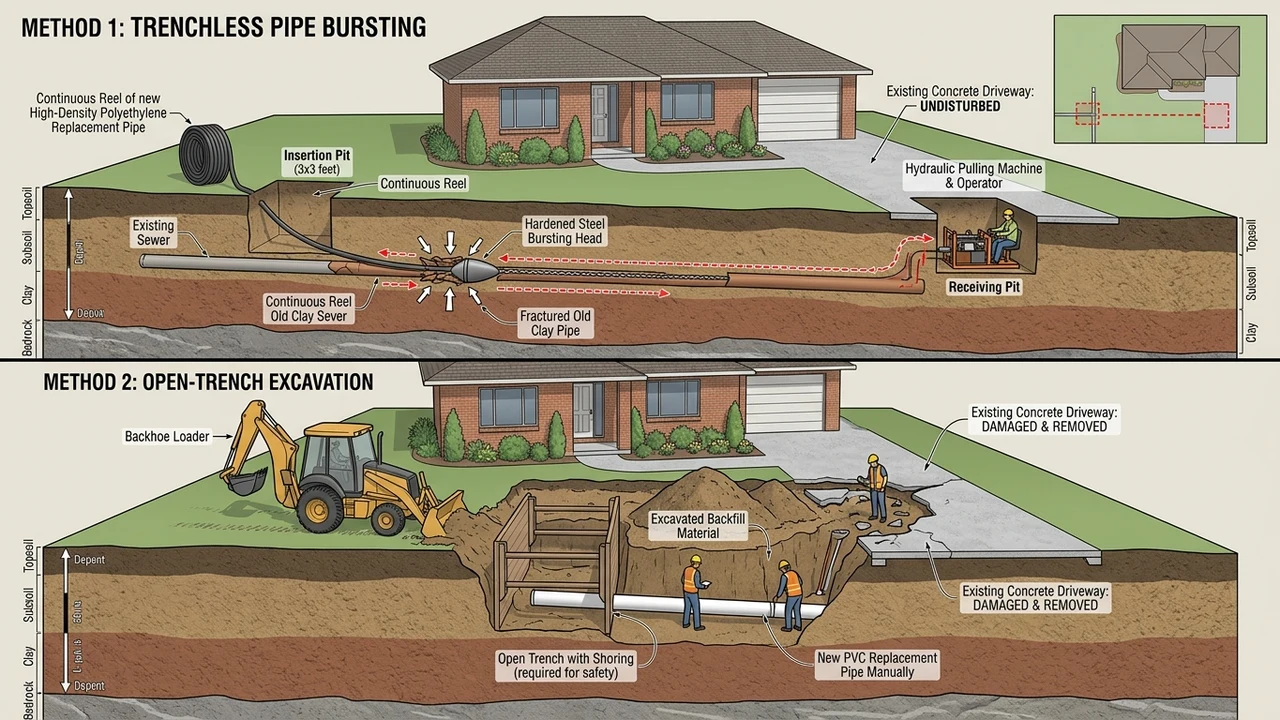
- Trenchless Sewer Replacement (Pipe Bursting): When a lateral line has suffered structural fracturing or severe root displacement, trenchless pipe bursting pulls a heavy-duty continuous High-Density Polyethylene (HDPE) line directly through the damaged old host pipe. This eliminates destructive trenching through landscaped yards, patios, or driveways.
- Exterior Cleanout Riser Installation: Older homes lacking direct ground-level access points benefit immensely from the installation of a dual-directional exterior ground cleanout riser, providing immediate full-bore access for future sewer inspections and high-velocity cleanings.
Frequently Asked Questions
Can a clogged toilet cause water to back up into the shower?
Yes. If an obstruction occurs in the shared branch drain line downstream of both the toilet and the shower, flushing the toilet forces wastewater down the line until it encounters the blockage. Because the shower drain pan sits at a lower physical elevation than the toilet bowl rim, the displaced water naturally pushes upward into the shower.
Should I use chemical liquid drain cleaners for a whole-house backup?
No. Pouring chemical drain cleaners into a whole-house backup is dangerous and completely ineffective. Harsh caustic chemicals cannot dissolve heavy tree roots, collapsed pipes, or massive main sewer blockages. Instead, caustic chemicals pool in standing sewage, creating severe chemical burn hazards for inspecting plumbers and accelerating corrosion on metal plumbing pipes.
How do plumbers know exactly where the main sewer pipe is damaged?
Plumbers utilize specialized inline sewer inspection cameras equipped with built-in 512 Hz radio transmitters (sondes). As the camera navigates the underground pipe to the obstruction, an above-ground digital locator wand tracks the radio signal, displaying the exact GPS coordinates and subterranean depth down to the inch.
Who is responsible for the sewer line between my house and the street in Pittsburg, CA?
In Pittsburg, California, residential property owners are legally responsible for the complete maintenance, repair, and structural replacement of their private sewer lateral pipe from the home’s exterior foundation wall all the way to the connection fitting at the municipal sewer main beneath the public street.
