
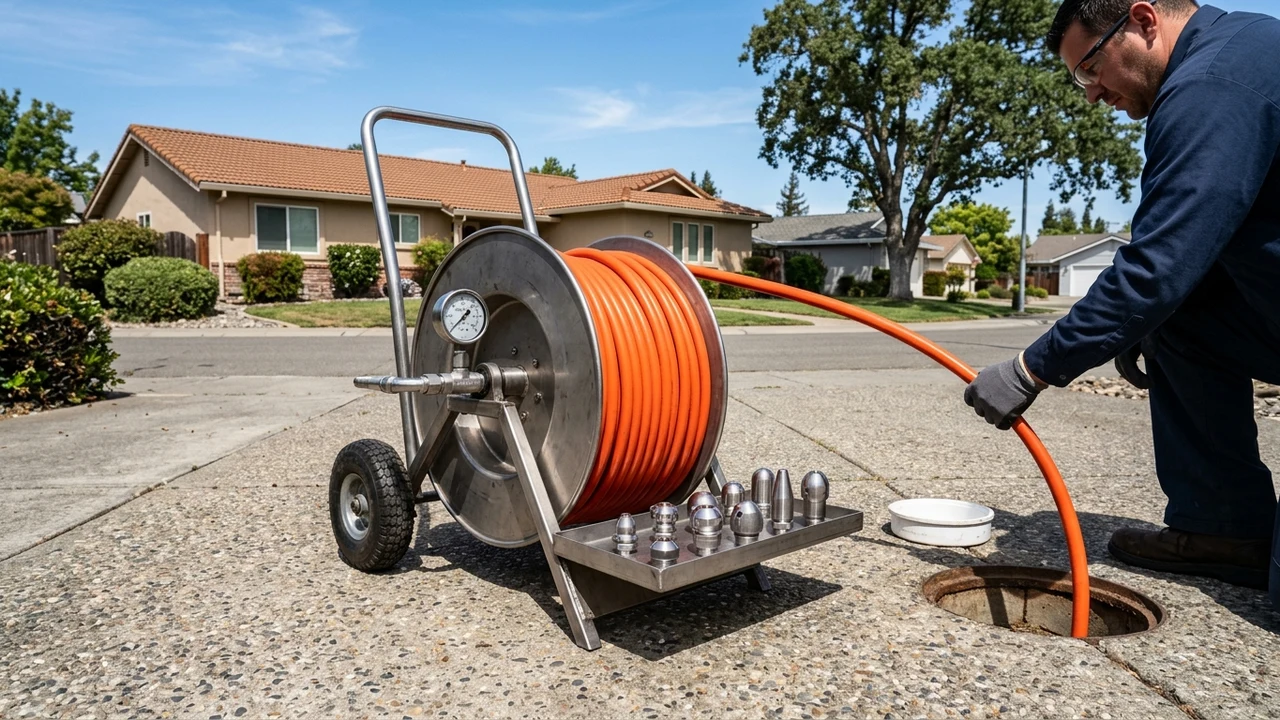
When a residential or commercial wastewater lateral line suffers a severe backup in Pittsburg, CA, property owners face a fundamental diagnostic decision: deploy a traditional mechanical drain snake or execute high-pressure hydro jetting. While both methodologies serve the broad discipline of sewer line restoration, their mechanical operating principles, hydraulic forces, and long-term descaling efficacy differ radically. Understanding which approach fits the physical blockage profile protects subterranean infrastructure across East Contra Costa County, eliminates recurring service calls, and prevents catastrophic structural collapses in aging municipal lateral connections.
The Mechanics: Hydro Jetting vs Traditional Mechanical Sewer Snaking
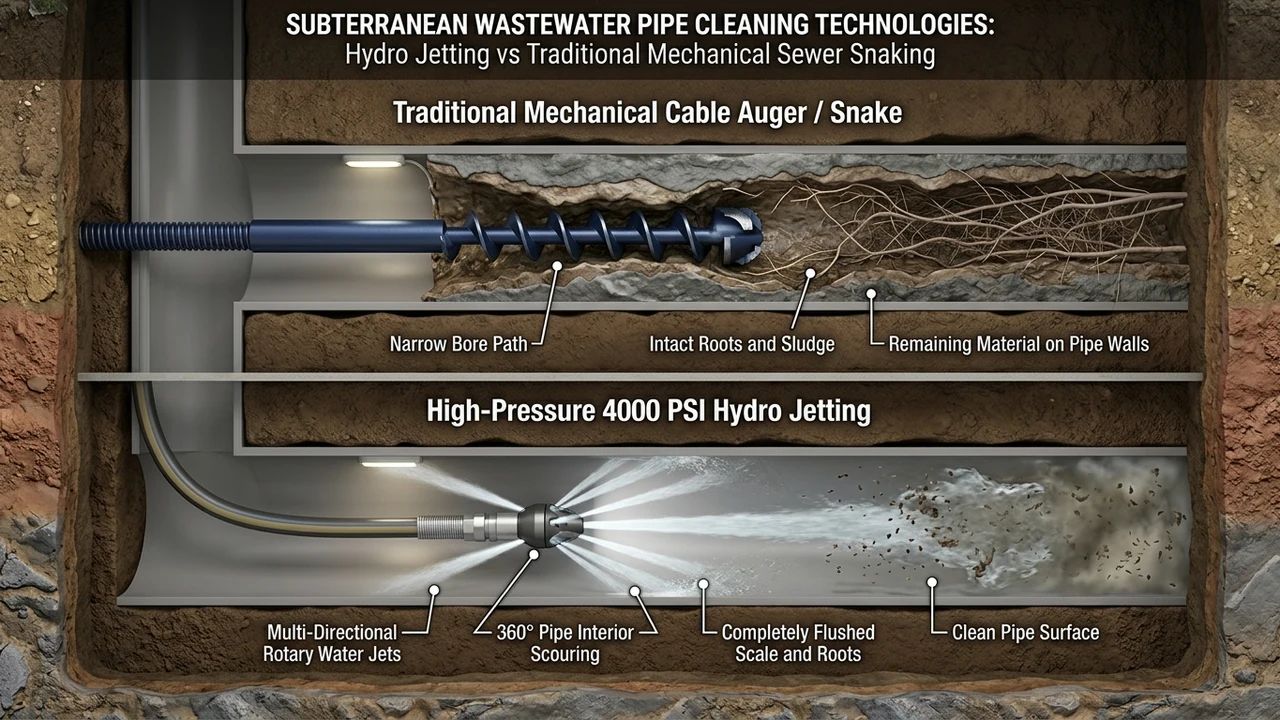
The operational divide between mechanical snaking and hydrodynamic jetting lies in the physics of material clearance. Each engineering discipline applies kinetic energy differently to dislodge subterranean waste obstructions, scale, and organic root intrusion.
How Mechanical Snaking Works: Cable Augers and Root Cutters
Mechanical sewer snaking, also known as continuous cable augering, utilizes a high-tensile, spring-wound steel cable driven by an electric motor rotating between 250 and 400 RPM. As the technician feeds the cable through an exterior cleanout riser, the forward-facing cutting head – typically a C-cutter, spade bit, or coiled bulb auger – impacts obstructions directly. The rotating head acts as a subterranean drill bit, boring a narrow puncture through compacted blockages, grabbing paper masses, or slicing through tender lateral tree roots. However, mechanical snaking only carves a core diameter equivalent to the cutting blade’s physical width (commonly 2 to 3 inches inside a 4-inch or 6-inch lateral pipe). The cable exerts minimal radial pressure against the internal pipe circumference, leaving perimeter coats of solidified grease, scale, and root mats completely intact.
How Commercial Hydro Jetting Works: 4,000 PSI High-Volume Scouring
Commercial hydro jetting represents a complete hydrodynamic restoration methodology. Utilizing a commercial-grade triplex plunger pump delivering water pressures between 3,500 and 4,000 PSI at flow rates of 12 to 18 gallons per minute (GPM), hydro jetting transforms water into a high-velocity shearing tool. The system operates via specialized rear-facing and forward-facing stainless steel nozzles connected to a heavy-duty, thermoplastic flexible hose. The rear-facing thrust jets propel the nozzle down the sewer lateral while scouring the pipe circumference at acute angles. Simultaneously, rotating forward-penetrating nozzles pulverize solid blockages ahead. As the hose is slowly retrieved under full pressure, the 360-degree radial water curtain completely strips fats, oils, grease (FOG), mineral scale, and root filaments from the pipe walls, flushing all pulverized detritus out toward the municipal main.
Diagnostic Criteria: Identifying the Underlying Sewer Line Failure Mode
Selecting between an auger and a jetter requires evaluating the chemical and structural nature of the blockage. Deploying the wrong tool either fails to resolve the failure mode or subjects fragile piping to unnecessary mechanical stress.
FOG Accumulation (Fats, Oils, and Grease) vs Soft Blockages
In residential kitchens and multi-unit housing complexes throughout Pittsburg, fats, oils, and grease represent the leading cause of chronic line restriction. When hot grease is washed down drains, it cools and saponifies along the interior walls of unheated underground pipes, forming dense, sticky deposits. When a mechanical snake is inserted into a grease-occluded pipe, the flexible auger simply pushes through the soft center, punching a temporary relief hole. Within days or weeks, the viscous perimeter grease relaxes, slumps back into the void, and re-establishes a 100% obstruction. Hydro jetting, conversely, emulsifies and shears grease down to bare pipe, eliminating the structural foundation required for subsequent FOG buildup.
Tree Root Intrusion in East Contra Costa County Soils
East Contra Costa County’s Mediterranean climate and expansive delta soils encourage vigorous root growth from mature eucalyptus, coastal oaks, liquidambars, and ornamental palms. Seeking subterranean water vapor, hairline root systems penetrate pipe joints, hairline fissures, and mortar seams in older sewer lines. Once inside, roots blossom into dense, fibrous root balls that capture toilet paper and sanitary waste. While mechanical root-cutting blades can chop through the central root mass to restore emergency drainage, they leave root collars embedded in the joint collars. Within 90 to 180 days, these severed root ends stimulate rapid regrowth. High-pressure hydro jetting equipped with specialized rotary root-cutting nozzles slices roots flush against the pipe wall, completely clearing the internal circumference and preparing the pipe for potential structural trenchless lining.
Mineral Scaling, Calcite, and Tuberculation in Aging Lateral Lines
Hard municipal water, high in calcium carbonate and magnesium, causes heavy mineral scale and calcite to precipitate inside residential drain lines over decades. In vintage iron installations, this is compounded by tuberculation – an electrochemical corrosion process that produces mounds of oxidized rust flakes and sharp ferric blisters. These jagged mineral encrustations snag waste and reduce wastewater velocity. A mechanical snake cable will simply skate over hard calcite and rust blisters without altering internal pipe geometry. High-pressure hydro jetting, however, shatters brittle calcite crystal matrices and shears away loose corrosion scales, restoring original hydraulic laminar flow characteristics.
Pipe Material Suitability & Structural Integrity Considerations in Pittsburg, CA
The subterranean plumbing landscape of Pittsburg, CA spans multiple architectural eras, each characterized by distinct piping materials requiring tailored pressure management to prevent structural line collapse.
Vitrified Clay Pipe in Historic Pittsburg Neighborhoods
In historic sectors such as Old Town Pittsburg and established downtown neighborhoods, homes built between 1920 and 1960 frequently utilize vitrified clay pipe (VCP) laterals. Vitrified clay is highly inert and completely impervious to wastewater chemicals, but it is structurally brittle and assembled in short 3-foot segments connected with mortar or slip seals. Over decades, East Bay soil shifting causes mechanical joint offsets. While vitrified clay comfortably withstands 4,000 PSI hydro jetting without wall erosion, severe joint offsets require calibrated nozzle navigation to prevent the steel nozzle head from catching on unaligned pipe lips.
Cast Iron Degradation: Tuberculation and Channeling
Homes built across the Pittsburg Highlands and central Contra Costa subdivisions during the mid-to-late 20th century typically rely on cast iron drain, waste, and vent (DWV) piping. Aging cast iron suffers from bottom-channel erosion and aggressive internal tuberculation. If bottom-channeling has worn the pipe floor paper-thin, excessive mechanical pressure from a whipping 3/4-inch mechanical snake cable can punch directly through the pipe invert into the subsoil. Professional plumbers in Pittsburg regulate hydro jetting pressures between 2,500 and 3,000 PSI on compromised cast iron lines, utilizing wide-angle descaling heads to smooth internal surfaces without blowing through deteriorated metal walls.
Modern ABS and PVC Lateral Lines
Modern residential builds and subdivisions in Southwest Pittsburg, Antioch, and Brentwood utilize rigid plastic pipelines – primarily Schedule 40 Polyvinyl Chloride (PVC) or Acrylonitrile Butadiene Styrene (ABS). These smooth-walled synthetic polymers exhibit exceptionally low friction coefficients. Modern plastic pipes are ideally suited for full-pressure hydro jetting, which quickly clears construction debris, paint residue, and biological biofilms without damaging the smooth thermoplastic pipe walls.
Comparative Performance Matrix: Efficiency, Longevity, and Cost
Evaluating sewer cleaning investments requires looking beyond initial emergency call costs to consider total lifetime value and drain service recurrence cycles.
Longevity of Results: Temporary Relief vs Long-Term Pipe Restoration
Mechanical snaking provides immediate emergency relief by puncturing a drain blockage, making it an excellent triage tool during an active interior overflow. However, because it leaves up to 70% to 85% of pipe residue on the lateral walls, recurrence rates remain high. Statistical tracking across residential properties in Contra Costa County shows that snaked grease or root blockages typically re-clog within 3 to 6 months. Hydro jetting, by contrast, delivers true restorative pipe cleaning. By removing 98% to 100% of accumulated grease, scale, and bio-slime, a hydro-jetted sewer lateral routinely remains completely free-flowing for 18 to 36 months or longer when paired with sensible household disposal practices.
Prevention of Future Blockages and Biofilm Formation
Wastewater pipes harbor dense bacterial biofilms – sticky matrices of microorganisms and extracellular polymeric substances that trap organic debris and emit noxious sewer gas odors. Mechanical snakes do nothing to remove bacterial slime. Hydro jetting scrubs the interior pipe perimeter completely clean, scouring away microbial slime layers and neutralizing organic odor sources at the molecular level.
The Mandatory Role of Pre- and Post-Jetting CCTV Video Inspections
Hydro jetting must never be performed blindly. Industry standards and local California plumbing codes mandate an initial high-definition CCTV sewer camera inspection before inserting high-pressure jetting equipment. The pre-jetting camera run establishes the exact structural baseline: locating bellies (standing water sags), identifying broken clay segments, pinpointing heavy root intrusion points, and verifying that the pipe has not collapsed. If a pipe exhibits structural cave-ins or longitudinal fractures, hydro jetting is withheld to prevent washing out surrounding support soil. Following the hydrodynamic scouring cycle, a secondary post-jetting CCTV video inspection provides visual verification that all FOG and root structures are eliminated, while confirming structural readiness for long-term service or trenchless lining rehabilitation.
When Mechanical Snaking Is the Better First-Response Option
Despite the overwhelming technical superiority of hydro jetting for systemic lateral maintenance, mechanical snaking remains indispensable in specific residential scenarios:
- Minor Localized Fixture Obstructions: Blockages located within a single toilet P-trap, bathroom lavatory, or shower drain are efficiently cleared using small mechanical hand augers or drop-head snakes without deploying commercial pressure rigs.
- Severe Structural Pipe Failure: When a CCTV camera reveals fractured, cracked, or collapsed pipe walls, high-pressure water risks blowing out remaining structural integrity or flooding surrounding subgrade bedding. An auger can cautiously retrieve soft paper blockage to temporarily relieve an active backup while an excavation repair is scheduled.
- Historic or Brittle Building Envelopes: Interior branch lines lacking exterior ground-level cleanouts make running commercial high-pressure water hoses through finished living rooms risky. Mechanical cables provide safer containment in sensitive finished interiors.
Professional Sewer Line Maintenance Standards for Pittsburg Homeowners
Maintaining municipal sewer lateral compliance under local sanitation standards – including guidelines enforced by the Delta Diablo Sanitation District and local building departments across Contra Costa County – requires proactive infrastructure stewardship. Homeowners in Pittsburg should avoid chemical pour-in drain cleaners, which generate caustic exotherms that damage aging pipes and fail to clear heavy root intrusions. Establishing a scheduled 2-year hydro jetting cycle for older homes with mature landscaping provides optimal protection against emergency wastewater backups, protects real estate equity, and ensures trouble-free wastewater drainage across every household fixture.
