
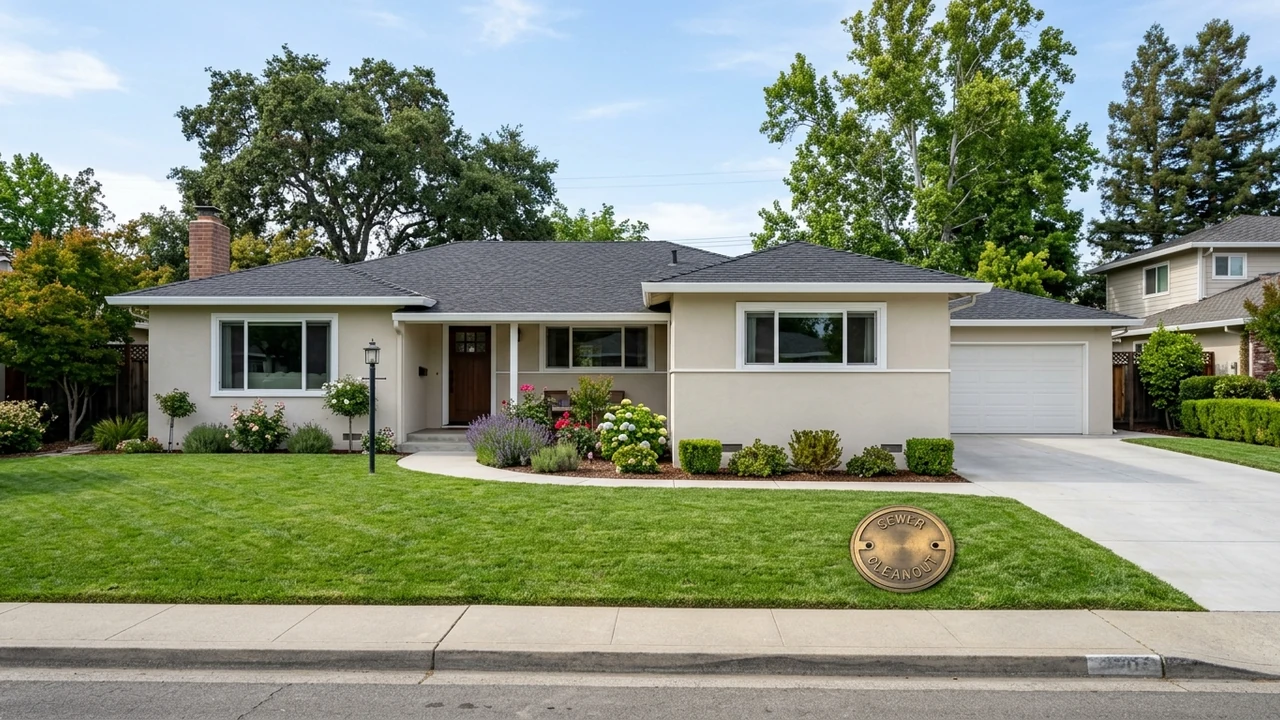
When sewer backup strikes a residential property in Pittsburg, CA, homeowners are immediately confronted with one of the most stressful decisions in residential maintenance: whether to commission trenchless sewer line repair or undergo traditional open-trench excavation. Between the rolling topography of the Pittsburg foothills, dense suburban neighborhoods near Buchanan Road and Railroad Avenue, and the expansive clay soil characteristic of East Contra Costa County, sewer laterals face severe physical stress. Understanding how modern trenchless rehabilitation compares with traditional excavation ensures you protect both your property’s plumbing infrastructure and your landscape investment.
Understanding Your Home’s Main Sewer Lateral
The sewer lateral is the underground pipeline connecting your home’s interior drain system to the municipal sewer main under the street. In Pittsburg, Antioch, Oakley, and Brentwood, property owners are legally responsible for maintaining the entire length of the lateral from the building cleanout up to the public sewer saddle connection. Over decades, subterranean pipes endure continuous ground shifting, aggressive tree root infiltration from mature eucalyptus and oak trees, and internal grease accumulation.
When structural failure occurs—whether from a deep fracture, offset joints, or full pipe collapse—simple drain snaking or chemical clearing cannot resolve the issue. At this stage, licensed plumbing contractors evaluate two primary restorative pathways: trenchless pipe replacement or open trenching.
What Is Trenchless Sewer Line Repair?
Trenchless sewer line repair encompasses modern non-invasive technologies that replace or rehabilitate damaged sewer laterals with minimal surface disruption. Rather than digging a continuous trench across front yards, concrete driveways, and decorative brick walkways, trenchless methods require only two small access points (an insertion pit and a receiving pit).
The two predominant trenchless methodologies deployed throughout East Contra Costa County include:
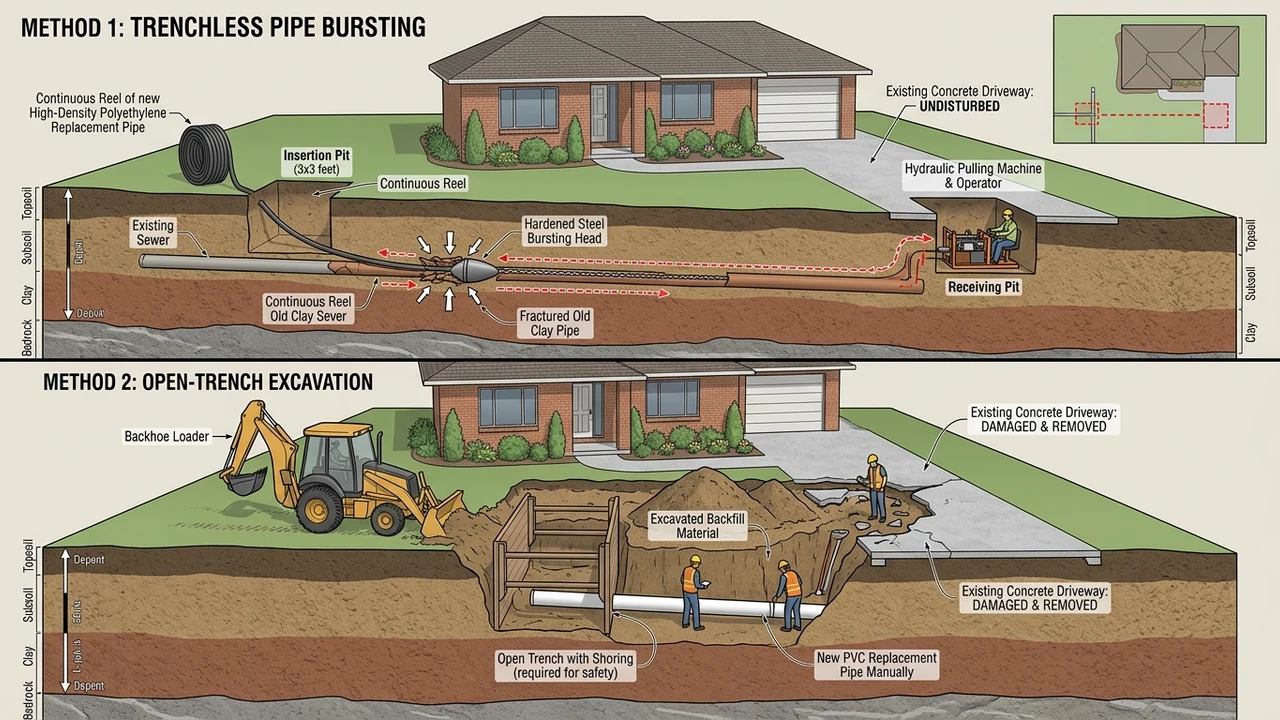
- Cured-in-Place Pipe (CIPP) Lining: An epoxy-saturated felt tube is inverted or pulled through the damaged host pipe, inflated, and cured with hot water or ambient air to form a jointless, smooth “pipe-within-a-pipe” that resists root intrusion for 50+ years.
- Trenchless Pipe Bursting: A hardened conical steel bursting head is pulled through the deteriorated clay or cast iron pipe, fracturing the old pipe outward while simultaneously pulling a seamless, high-density polyethylene (HDPE) replacement pipe into its place.
What Is Traditional Open-Trench Sewer Excavation?
Traditional sewer excavation involves utilizing heavy machinery, such as mini-excavators or backhoes, to dig a continuous trench directly above the existing sewer lateral from the house exterior foundation wall all the way to the municipal main connection at the curb or roadway. Technicians physically remove the damaged host pipe segments and lay new PVC (polyvinyl chloride) or ABS pipes on a compacted gravel bed.
While traditional excavation has been the industry standard for over a century, the collateral costs—including destroying paved driveways, concrete porches, manicured lawns, and retaining walls—often make the total project footprint far larger and more time-consuming than the plumbing repair alone.
Comparative Analysis: Trenchless vs. Traditional Excavation
To assist East Bay property owners in evaluating their options, the following comparison highlights key technical and operational differences:
| Evaluation Criteria | Trenchless Sewer Repair (Bursting / CIPP) | Traditional Trench Excavation |
|---|---|---|
| Surface Disruption | Minimal (2 small access pits of roughly 3×3 feet) | Extensive (Continuous 4-to-8-foot-deep open trench) |
| Project Completion Timeline | Typically 1 to 2 business days | 3 to 7 business days plus landscaping remediation |
| Hardscape / Driveway Impact | Pipes routed beneath driveways without cutting concrete | Requires saw-cutting concrete, asphalt, and walkways |
| Tree Root Resistance | Seamless HDPE or jointless epoxy eliminates root seams | Glued PVC joints can shift under soil pressure over time |
| Permitting & Municipal Inspection | Standard Pittsburg municipal plumbing permits | Street excavation, traffic encroachment, and trench permits |
| Expected Lifespan | 50 to 100 years for HDPE and epoxy liner systems | 50+ years for modern schedule 40 PVC piping |
Why East Contra Costa Soil Conditions Influence Sewer Health
Pittsburg and surrounding communities throughout East Contra Costa County are renowned for expansive adobe clay soils. During wet California winters, these clays absorb significant moisture, expanding and exerting upward and lateral hydrostatic pressure on underground plumbing. Conversely, during hot summer months, the soil shrinks and fissures, creating shifting soil pockets.
This perpetual expansion and contraction cycle causes rigid clay and brittle cast iron sewer lines to shear, crack, or develop pipe bellies (low spots where water and waste pool). Trenchless HDPE pipe bursting provides superior resilience against this ground shifting because the continuous fused plastic pipe flexes slightly with tectonic and soil movements without separating at the joints.
Diagnostic Video Camera Inspection: The Critical First Step
Before selecting a repair strategy, a licensed Pittsburg plumbing specialist must conduct a high-definition sewer video camera inspection. A specialized fiber-optic camera with an integrated 512 Hz sonde transmitter is inserted into the main cleanout, transmitting real-time footage of the pipe interior to an inspection monitor.
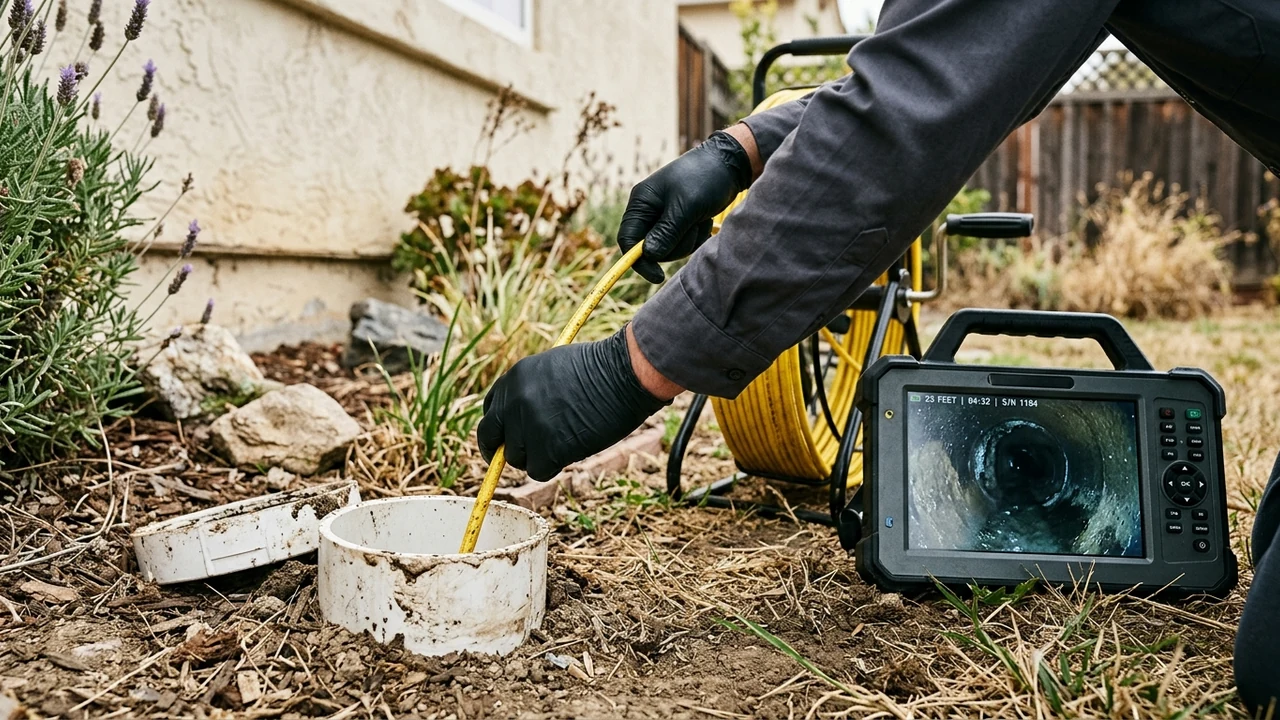
This diagnostic assessment determines:
- The exact depth, linear distance, and location of structural fractures.
- Whether the pipe has suffered a total collapse that would prevent a bursting cable from passing through.
- The degree of pipe grade and whether low-velocity bellies exist.
- Existing pipe materials (vitrified clay, Orangeburg, cast iron, or transitional plastic).
When Traditional Excavation Remains Necessary
While trenchless methods are preferred in roughly 80% of residential sewer projects, certain scenarios necessitate open-trench excavation:
- Severe Pipe Collapse: If the existing pipe has completely crushed and soil has filled the cavity, a trenchless cable or liner bladder cannot navigate the void.
- Negative Slope or Reverse Grade: Trenchless relining follows the existing contour of the host pipe. If your lateral was originally installed with improper downward slope, trenching is required to regrade the ditch bed.
- Severe Joint Offsets: When tectonic movement has displaced pipe joints by multiple inches, trenchless heads may divert into surrounding soil rather than along the pipe axis.
Permitting and City of Pittsburg Compliance
All sewer lateral replacements in the City of Pittsburg require appropriate plumbing permits and must adhere to Contra Costa County sanitation district codes. Professional trenchless installations require verification of cleanout access at the property line, adequate backwater valves to prevent municipal main surcharges, and a formal water pressure or air test before final inspection sign-off.
Conclusion and Next Steps for Pittsburg Homeowners
Addressing a compromised sewer lateral quickly prevents hazardous sewage backups, foundation soil saturation, and costly emergency cleanups. For property owners across Pittsburg, Antioch, Oakley, and Brentwood, trenchless sewer replacement offers an engineered, non-destructive solution that restores full drainage capacity while keeping your yard, patio, and driveway intact.
